
How to Optimize Custom Printed Rollstock for VFFS Lines Without Causing Downtime?
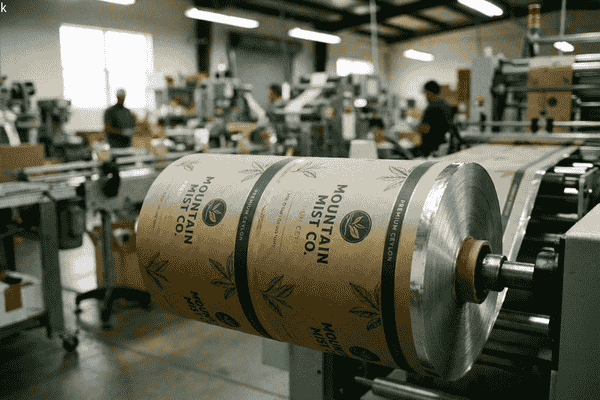
I have watched custom printed rollstock turn a “healthy” VFFS line into a stop-and-go mess, even when the bags looked fine during the first slow trial.
To avoid this problem, I optimize custom printed rollstock for VFFS by treating artwork, film SPECs, and machine setup as one system. I lock the film targets to the real line, then standardize setup and tests so speed increases will never trigger blocking, misfeeds, or weak seals.
Most downtime isn’t due to “bad luck” but rather stems from subtle specification defects that only become apparent at mass-production speeds. I will now reveal where these defects lie and how to eliminate them before large-scale production.
1. What Is Custom Printed Rollstock and How It Works on VFFS Packaging Lines?
When people say rollstock is “just film on a roll,” I know the next sentence will be about jams, short bags, or seal leaks.
Custom printed rollstock is a printed web that a VFFS machine unwinds, forms into a tube, seals, fills, and cuts in one continuous cycle. On high-speed lines, small changes in friction, stiffness, print repeat, or sealant behavior can shift registration and sealing enough to cause downtime.

The VFFS production line is not a “running film”. It is the link that connects “the entire process from start to finish”.
How rollstock moves through a VFFS line
Unwind, tension, and inertia
A full roll has high inertia. A small roll has low inertia. If unwinding control cannot compensate for this, changes in the roll diameter will cause tension drift. Therefore, roll manufacturers typically only achieve 80-90% roll coverage, with a slight reduction in tension.
Tracking, guiding, and edge forces
If the roll is cambered or telescoped, the web “wants” to walk. Edge guiding can correct small drift, but it cannot fight a roll geometry problem forever. Therefore, each roll must be of standard width and wrinkle-free.
Forming collar and tube friction
The inside surface must slide over metal. If it drags, belts slip or the web wrinkles. Wrinkles then travel into the vertical seal area and create weak seals that look random.
Pull belts and registration logic
Belts need traction against the outside surface. If the outside is too slippery, belts slip and bags go short. If the outside is too “grabby,” the web jerks and the photo-eye hunts.
Sealing and cutting
Typically, the heat sealing temperature for roll materials is maintained between 150 and 180 degrees Celsius. However, the success of the seal depends not only on temperature but also on pressure, residence time, and the sealing window of the film. Higher air-blowing frequencies (BPM) require shorter residence times. A film that seals well at 50 BPM may fail to seal at 120 BPM.
A simple “three-fit” model that prevents surprises
| Fit area | What must match | What downtime looks like |
|---|---|---|
| Mechanical fit | width, roll OD, core, winding, stiffness | wrinkles, tracking faults, misfeeds |
| Control fit | COF balance, stable tension, eye mark design | registration drift, short bags, false alarms |
| Thermal fit | sealant type, seal window, hot tack behavior | leakers, blowouts, seal failures at speed |
If the purchasing department only locks in the thickness and price, but fails to confirm other dimensions and specifications, it can easily lead to downtime during the production ramp-up phase, even if no errors occur during trial runs.
2. Why Custom Printed Rollstock Causes Blocking, Misfeeds, and Sealing Failures?
I often see a team blame the rollstock manufacturer first. But in many cases, the machine is only exposing a film mismatch that was already there. A few minor adjustments are all it takes to get it working smoothly.
Custom printed rollstock causes blocking, misfeeds, and sealing failures when friction, winding, ink/varnish, and sealant behavior do not match real line speed, tension, and jaw settings. At high speed, small spec variance becomes a stop, not a minor defect.

There is a reason companies track downtime so closely: even small stoppages scale into big losses. One industry metric cites that unscheduled downtime can sap 11% of annual revenues for the world’s largest companies, totaling $1.4 trillion, and quotes extreme per-hour costs in automotive manufacturing. (ismworld.org) That is why film-related micro-stops matter.
Blocking: film-to-film friction and winding pressure
Blocking is when layers stick together in the roll, or when finished bags stick and jam downstream.
What usually causes blocking
- Film-to-film friction too high for the storage and unwind conditions
- Winding tension too tight, creating pressure and heat buildup inside the roll
- Slip / anti-block imbalance, where surface additives migrate unevenly
- Ink or varnish cure issues, where the surface stays tacky and transfers
I want to clarify a misconception: Even with the same price and materials, differences in the thickness of the composite layers can lead to different final packaging. That is why I push for a controlled COF target, not a “nice-feeling” surface.
Misfeeds: belt traction, web drag, and tension drift
Misfeeds often show up as short bags, long bags, or sudden registration faults.
The most common root causes
- Outside COF too low: belts cannot grip consistently
- Outside COF too high: drag increases and feed becomes unstable
- Belts contaminated: dust or ink transfer reduces traction
- Tension too high: film stretches, so the machine “moves web,” but print does not land where expected
A practical COF reference used in the flex pack industry is that values over 0.50 are often treated as non-slip surfaces, while values below 0.20 are treated as high-slip films that can be prone to roll telescoping. (Poly Print) This does not replace real trials, but it helps spot extremes that usually bring trouble.
Sealing failures: “looks sealed” is not “sealed at speed”
VFFS sealing failures often appear only after speed-up.
Three failure modes that create downtime
- Cold seals at speed
Dwell time drops as BPM rises. If the seal window is narrow, seals become weak fast. - Channel leaks
Ink, varnish, dust, or product fines in the seal area create micro-channels. - Hot tack failures and blowouts
Bags are stressed while seals are still hot. If the sealant has poor hot tack, bottom seals can peel open during product drop.
A quick downtime diagnosis table
| Symptom | Likely film cause | Likely line condition | What to check first |
|---|---|---|---|
| Film sticks in roll | high film-to-film friction, winding too tight | hot storage, heavy pallets | roll hardness + unwind feel |
| Short bags | outside too slippery, stretch-prone web | belt slip, high tension | measure cut drift over 20 bags |
| Wrinkles at collar | inside drag, stiffness mismatch | collar misalignment | listen for squeal + inspect tube |
| Seal leaks at speed | narrow seal window, ink in seal area | dwell too short at high BPM | seal test after ramp-up |
3. How to Select COF, Sealant Layers, and Print Structures for High-Speed Running?
I have seen buyers order a “standard” structure, then spend weeks tuning the machine. The faster path is to specify the film so the machine does not need heroic tuning.
In fact, all high-speed VFFS systems now offer detailed roll material parameters. As long as you purchase the roll material according to these parameters, you should generally not encounter any problems. I will select a sealing material with a wide sealing window and high fault tolerance based on the parameters, and ensure that the printed structure will not contaminate the seal or change the friction under heating conditions. This can prevent problems such as belt slippage, collar dragging, and seal failure during acceleration.
Step 1: Specify COF as two different requirements
- Outside COF (print side to belts): controls traction and stable pulling
- Film-to-film COF: controls roll unwind smoothness and blocking risk
Many teams ask for “a COF.” That is not enough. A single number cannot describe three different contact needs.
Here is the part I always make practical: there are no universally “good” COF values, but extremes are risky. Industry guidance often treats >0.50 as non-slip and <0.20 as high-slip that can telescope. (Poly Print) The target should be chosen by the machine’s belt design, collar geometry, and speed.
Step 2: Choose sealant layers for the real sealing window, not the lab seal
Sealant choice should start from: speed, jaw type, dwell time, and product drop stress.
What must be defined up front
- Seal initiation behavior at your speed range
- Hot tack performance under product drop conditions
- Contamination tolerance if product dust exists
- Temperature window that operators can control reliably
This is where my second story belongs, because it shows why “standard” does not work at speed.
One of my American client used metallized white kraft paper rolls for tea bags. The line ran very fast, but the ordinary CPP inner layer could not heat-seal tightly. After we reviewed the real line speed and jaw conditions, we changed the inner formula from CPP to BOPP and added low-temperature dissolving particles to improve sealing response. After re-testing, the line became stable and held 300–400 bags per minute. The client was satisfied because the fix matched the machine reality, not the old assumption.
That is also why I do not let “same artwork” imply “same film.” A gloss change, a matte varnish, or a different sealant can change friction and sealing at the same time.
Step 3: Design print structure for sensor reliability and seal cleanliness
A printed web is not only graphics. It is a functional surface.
Print rules that protect uptime
- Keep ink-free seal margins. If ink enters the sealing area, ensure the printed ink does not affect the heat-sealing effect.
- Use high-contrast eye marks with a quiet zone. Busy graphics near the mark cause misreads.
- Keep critical claims away from cut lines and seal lines, so small registration drift does not destroy appearance.
- Avoid spot varnish patterns where pull belts contact the film, because mixed friction zones can cause slippage.
A selection table for RFQs and approvals
| Item to lock | What to ask the supplier | What to document |
|---|---|---|
| COF targets | outside / film-to-film targets | test method + tolerance window |
| Sealant | seal window + hot tack expectation | jaw type + speed + product drop notes |
| Print system | ink/OPV heat resistance | seal margins + cure standard |
| Roll build | winding tension, splice rules | core, max OD, splice type + flagging |
If you are unclear about the data above, you can directly seek help from our team.
4. What to Test on Your Machine Before Approving Mass Production?
I have approved films that looked perfect at slow speed. Then mass production started and downtime appeared. This was the first mistake of my career. That pain is avoidable with a short test plan.
Before mass production, I test rollstock on the exact VFFS line at ramped speeds, confirm registration stability, verify seals after speed-up, and validate roll and splice behavior through changeovers. This catches friction drift, ink transfer, and seal window gaps before downtime hits.
The approval goal is stability across time, not a good first bag
A VFFS line changes during a run:
- roll diameter drops
- tension changes if unwind control is not tuned
- belts warm up
- jaws accumulate residue if ink transfers
- operators change settings under stress
Approval must include those realities.
A 4-stage VFFS compatibility test plan
| Stage | Run condition | What to measure | Pass criteria |
|---|---|---|---|
| A: Setup | standard threading + recipe | tracking, wrinkles, mark reading | stable web path, clean sensor read |
| B: Speed ramp | 50% → 80% → 100% speed | registration drift, alarms | cut position stays within tolerance |
| C: Seal window | adjust within safe limits | seal strength after ramp-up | stable seals without overheating |
| D: Roll-end + splice | near low OD + splice pass | jams, tension spikes, residue | no splice jams, no jaw contamination |
The minimum tests that prevent expensive surprises
Registration stability test (simple and fast)
Run 20–50 bags at each speed step. Measure cut-to-graphic position. If drift grows with speed, it is usually traction or tension, not “bad printing.”
Seal integrity test after ramp-up
Test seals after the line reaches target BPM. Seals that pass at low speed can fail when dwell time shrinks.
Visual residue inspection
Stop after 15–30 minutes. Inspect jaws and belts for ink or varnish transfer. Residue today becomes downtime tomorrow.
COF verification by lot
COF can drift by lot, storage, and time. That is why an incoming QA check matters. Industry sources describe standardized film COF measurement practices and why COF is used to compare frictional surface behavior. (Poly Print)
Request a VFFS Rollstock Compatibility Review
Based on your machine model, line speed, and sealing conditions—before mass production. If you share your VFFS model, target BPM, jaw type, product weight, and current structure, I will map COF targets, sealant, and print structure to your real conditions so ramp-up is predictable. Alternatively, you can visit our rollstock page for more details.
Conclusion
Custom printed rollstock runs reliably on VFFS when COF, sealing, and artwork are engineered for the real line, then proven by a short ramp test before mass production. This will ensure that there are no problems with your bulk production.
Sources (External links)
- Downtime impact data (11% of annual revenues; $1.4T; $2.3M/hour in automotive; $125,000/hour cited from ABB survey): (ismworld.org)
- COF thresholds used in flex pack (over 0.50 non-slip; under 0.20 high-slip and telescoping risk): (Poly Print)
- Data context for packaging film scale (global plastics production 368 million tons in 2019; ~40% used in packaging, showing why film efficiency and waste reduction matter): (pmc.ncbi.nlm.nih.gov)