Flexible Packaging vs. Rigid Packaging: Which Is More Cost-Effective for Your Supply Chain?
Struggling to decide between flexible packaging vs rigid packaging for your products? You’re not alone. Many buyers compare only unit price, then later realize warehousing, shipping, and damage costs tell a very different story. The good news: once you look at total landed cost, the answer becomes much clearer. In this guide, we’ll break down costs, sustainability, and the consumer experience so you can choose the right format for your brand and supply chain.
Comparing Total Landed Costs: Shipping, Warehousing, and Materials
When I compare flexible packaging vs rigid packaging with customers, I never start with “price per piece.” Instead, I begin with total landed cost: materials, freight, warehousing, damage, and handling. This is where flexible packaging usually pulls ahead.

1. Materials and Packaging Purchase Cost
Flexible packaging (pouches, bags, films) generally uses far less material than rigid formats like glass, cans, or thick plastic tubs. Many studies and converters report 30–60% lower total delivered cost for flexible formats when shipping and storage are included. (packagingbest.com)
Typical Cost Positioning (Illustrative)
| Format Type | Material Usage (by weight) | Relative Packaging Cost | Notes |
|---|---|---|---|
| Glass jars / bottles | 100% baseline | $$$ | Heavy, fragile |
| Metal cans | 70–90% of glass | $$–$$$ | Strong, but metal prices vary |
| Rigid plastic tubs | 40–60% of glass | $$ | Lighter, still bulky |
| Flexible pouches / bags | 5–15% of glass | $–$$ | Highest product-to-package ratio |
Flexible packaging often uses 70–90% less material by weight than rigid alternatives, reducing not only material costs but also waste-handling and EPR-related fees in many markets. (flexpack.org)
2. Warehousing and Storage Costs
This is where flexible packaging vs rigid packaging becomes a landslide.
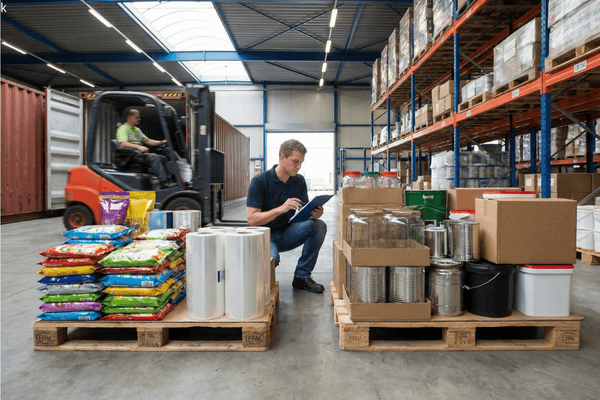
Empty rigid containers ship fully formed. Empty flexible packaging ships flat—on rolls or in stacks. That difference can free up entire rows in your warehouse.
Empty Packaging Footprint Comparison
| Metric | Flexible Packaging | Rigid Packaging |
|---|---|---|
| Space for 100,000 units (typ.) | 1 pallet (flat pouches/roll stock) | 8–25 pallets (bottles/jars/tubs) |
| Storage mode | Flat, high stacking on racks | Bulky, limited stack height |
| Warehouse cost impact | Lower rent, fewer extra racks needed | Higher fixed storage and handling cost |
Packaging specialists show that compact packaging and “right-sized” designs can significantly reduce rack positions and even delay warehouse expansion—another hidden saving flexible formats unlock. (Pregis)
If your warehouse is tight or rent is high, flexible formats quickly become the more cost-effective choice.
3. Transport and Freight
Once filled, flexible packaging still keeps a strong advantage on weight and space. Rigid formats “ship air” and heavy material. Flexible formats mostly ship product.
Freight Economics Snapshot
| Factor | Flexible Packaging | Rigid Packaging |
|---|---|---|
| Product-to-package ratio | Up to 97:3 | Often 85:15 or worse |
| Truck/container utilization | More units per load | Fewer units per load |
| Dimensional weight impact | Lower (soft, compact shapes) | Higher (fixed, bulky shapes) |
| Fuel cost per unit | Lower | Higher |
Case studies from converters and brands often report 15–40% freight savings when switching from rigid containers to flexible pouches, especially in cross-border shipping. (standuppouches)
Quick Decision Guide: Cost & Operations
Use flexible packaging if:
- Shipping cost is a major pain point (export, long-distance, or high volume).
- Warehouse space is limited or expensive.
- You want to reduce packaging material cost and EPR-related fees.
- You run (or plan to run) high-speed form-fill-seal lines.
You might stay with rigid packaging if:
- Your product is very fragile or needs strong crush resistance.
- You rely on premium “heavy” packaging to justify higher retail pricing.
- Your current lines are optimized only for rigid formats and changeover would be huge.
If you work in tea or dry food and want to visualise this with your own SKUs, you can benchmark formats against our flexible roll stock for food packaging.
Sustainability Impact: Why Flexible Packaging Reduces Your Carbon Footprint
Many buyers assume that “more rigid” or “more recyclable” means “more sustainable.” In reality, total environmental impact is a balance of material use, transport, energy, and end-of-life options.

1. Material and Emissions
Because flexible packaging uses much less material, it usually has a lower carbon footprint per filled unit than equivalent rigid formats, even if those rigid formats are more easily recycled.
Life cycle and industry research show:
- Replacing plastic packaging with heavier “alternative materials” like glass, metal, or paper would increase greenhouse gas emissions, mainly because of extra weight and production energy. (Plastics Europe)
- Flexible pouches typically have a better product-to-package ratio and can outperform boxes and bottles in overall environmental impact. (ZACROS AMERICA)
Environmental Comparison (High-Level)
| Aspect | Flexible Packaging | Rigid Packaging |
|---|---|---|
| Material usage | Very low (lightweight films) | High (glass, thick plastic, metal) |
| Manufacturing energy | Lower for most film structures | High (especially glass & metal) |
| Transport emissions | Lower (lighter, compact loads) | Higher (heavier, more trips) |
| Landfill volume | Lower per functional unit | Higher per functional unit |
2. The Recycling vs. Footprint Trade-Off
The weak point of flexible packaging is curbside recyclability. Multi-layer films with barrier structures are still difficult to recycle in many countries. Rigid glass, PET, and aluminum often enjoy better-established recycling streams.
So the sustainability trade-off becomes:
- Flexible:
- √ Lower material use
- √ Lower transport emissions
- × Harder to recycle (today)
- Rigid:
- √ Easier to recycle (in many markets)
- × Heavier, more material
- × Higher transport and production emissions
In markets where Extended Producer Responsibility (EPR) fees are weight-based or emissions-based, flexible packaging can still win overall, even with lower recycling rates, because the “footprint per unit of product” is lower.
The global flexible packaging market’s steady growth—driven by food, beverage, and e-commerce—shows how many brands are making this same calculation. (Fortune Business Insights)
3. Practical Sustainability Strategy for Buyers
If you choose flexible packaging vs rigid packaging and still want a strong sustainability story, you can:
- Use paper-based laminates where possible (e.g., paper/PE or paper/PBS).
- Specify thinner structures with the same barrier (optimize OTR/WVTR instead of over-engineering).
- Look for recycle-ready mono-material films in markets where collection exists.
- Share the product-to-package ratio and carbon saving on your website or spec sheets.
For tea or dry foods, you can easily communicate this on your “sustainability” or tea packaging materials pages.
Shelf Appeal and Consumer Convenience: A Side-by-Side Comparison
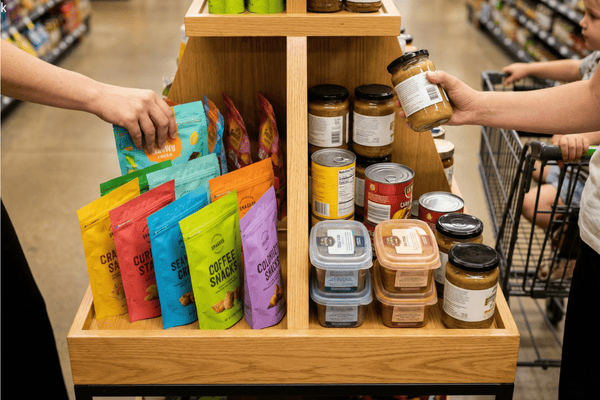
Cost and sustainability are not the only drivers. On the shelf and in the consumer’s hand, flexible packaging vs rigid packaging delivers very different brand experiences.
1. Brand Perception and Premium Feel
Rigid packaging still offers a strong premium signal:
- Heavy glass jars and tins feel more “luxurious.”
- Rigid boxes feature immaculate edges and a strong shelf presence.
- Complex shapes and opening mechanisms are easier to achieve.
Flexible packaging has improved a lot with high-quality gravure/flexo printing, soft-touch varnishes, and shaped pouches, but it will never feel like glass in the hand. For some premium SKUs, that weight is part of the story.
Brand & Shelf Comparison
| Dimension | Flexible Packaging | Rigid Packaging |
|---|---|---|
| Perceived premium | Medium (good printing, lighter feel) | High (weight, structure, “gift-worthy”) |
| Design flexibility | High for graphics; medium for shape | Medium graphics; high for 3D shape |
| Space on shelf | Compact, can hang or stand | Fixed footprint; often deeper / wider |
| E-commerce suitability | Very good (light, shatterproof) | Risk of breakage, heavier returns |
2. Consumer Use and Convenience
Here flexible packaging often wins clearly:
- Easy opening features (tear notches, laser scoring, zippers).
- Resealable closures that keep products fresh.
- Lightweight and easy to carry—especially for snacks, tea, and powders.
- Better for e-commerce: shatterproof, less risk of breakage.
Rigid packaging still has advantages for:
- Liquids that must be poured with precision.
- Products stored long-term on a fixed shelf (e.g., glass jars in kitchens).
- Situations where consumers reuse the container (e.g., tins, glass jars).
3. What This Means for Your Product Line
Many brands now mix both formats:
- Flexible for everyday SKUs where cost, convenience, and sustainability matter.
- Rigid for gift sets, hero products, or premium lines where design and “unboxing” experience justify higher cost.
For example, a tea brand might use:
- Paper/foil stand-up pouches for standard refills (flexible, low-cost).
- Rigid tins or tubes for gift collections (premium, higher margin).
From a supply chain view, this hybrid model still captures most of the cost and sustainability benefits of flexible packaging, while keeping rigid for specific SKUs where it truly adds value.
Conclusion
When you compare flexible packaging vs rigid packaging across your full supply chain—not just unit price—flexible formats usually deliver lower total landed cost, smaller carbon footprint, and better logistics efficiency. Rigid packaging still has a place for fragile or premium products, but for high-volume, fast-moving goods, flexible packaging is often the more cost-effective choice when product protection and line performance are confirmed.
External References (for further reading)
- Flexible vs rigid cost and TCO discussions – StandUpPouches (standuppouches)
- Environmental performance and product-to-package ratios – FlexPack Europe & Glenroy case studies (flexpack-europe.org)
- Flexible packaging market growth and trends – Fortune Business Insights (Fortune Business Insights)