flexible packaging manufacturer

Why Are My Tea Pouch Seals Not Strong Enough When Buying from China?

Contents

Why Are My Tea Pouch Seals Not Strong Enough When Buying from China?

Struggling with weak or leaking tea pouch seals from China? You’re not alone. Many importers face this frustrating issue—pouches that look perfect on arrival but fail on the shelf, leaking aroma, losing freshness, or even bursting during shipping. The good news? Weak seals aren’t random—they’re preventable. In this guide, you’ll learn what causes seal failure, how to test materials before shipment, and how to communicate precise specs with your supplier to secure consistent, airtight seals. Let’s get started.


Understanding Weak Seals

The Hidden Risks in Tea Packaging Sourcing

When importing tea pouches from China, weak seals can quickly become costly. A single weak point can compromise product freshness, reduce shelf life, and damage your brand’s reputation.

Seal strength issues typically arise from three key areas: material quality, machine settings, and process control. Factors like uneven temperature, thin sealant layers, or poor lamination often go unnoticed until it’s too late.

Why does this happen so often in China sourcing?
Many suppliers prioritise price over process. That can mean thinner films, lower-quality adhesives, or uncalibrated sealing machines. Add long international transit—hot containers, high humidity, vibration—and even minor flaws turn into leaks.

By understanding these root causes early, you can protect your packaging quality, maintain freshness, and reduce costly returns.


Step 1: Identify What Causes Weak Sealing on Multilayer Films

Weak sealing isn’t just bad luck—it’s a process problem waiting to be solved. Most multilayer films used for tea (such as PET/AL/PE or Paper/PLA) require precise control of sealing.

Diagram showing multilayer flexible packaging film structure with outer, barrier, tie, and food contact layers bonded together using PU adhesive.
A cross-sectional diagram of multilayer flexible packaging showing how PET, PA, and PE layers are bonded with tie and barrier layers for strength, sealing, and protection.

Common Causes of Weak Sealing

CauseDescriptionWhy It Matters
Low Seal TemperatureThe inner film doesn’t reach the melting point.Creates a “false seal” that looks closed but peels easily.
Uneven PressureJaw misalignment or worn PTFE tape.Causes one side to bond more strongly than the other.
ContaminationTea dust or oil between films.Blocks fusion and creates air channels.
Thin Sealant LayerInconsistent coating weight (less than 18–25 g/m²).Reduces bonding area, especially on wide bags.
Poor Lamination BondingAdhesive under-cured or uneven.Weakens the inner support layer, leading to delamination.

If your supplier can’t explain these variables clearly, it’s time to ask more profound questions—or send a sample roll for testing before full production.


Step 2: Master Seal Temperature and Time Control

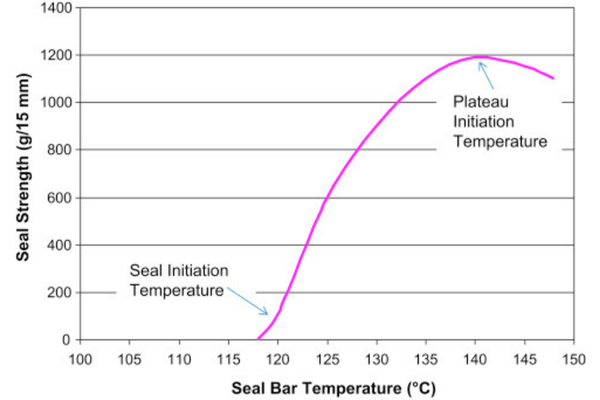
Temperature is the heart of seal strength. Even a slight variation can make or break a pouch.

Graph showing the relationship between seal bar temperature and seal strength for heat seal materials, highlighting seal initiation and plateau initiation temperatures.
A scientific graph illustrating how seal strength increases with temperature until reaching the plateau initiation point. Source: ScienceDirect – Seal Initiation Temperature

To achieve a durable seal, you need a balance between heat, pressure, and dwell time—known as the “golden triangle” of sealing.

Practical Temperature Tips

MaterialIdeal Sealing RangeNotes
LLDPE/PE130–150°CMost common for tea; good flexibility.
CPP150–170°CFor heavier pouches; slower sealing speed.
PLA/PBS110–130°CSensitive to heat; requires steady temperature.
Paper/AL/PE135–150°CFor barrier bags with an aluminium layer.

Pro tip:
Request your supplier’s seal strength curve, a graph of seal force versus temperature. This data reveals the ideal window for your machine.

Also, verify temperature calibration. In some factories, the display shows 150°C, while the actual bar only reaches 140°C. That 10°C difference can cause seal failures across thousands of pouches.


Step 3: Balance Pressure and Dwell Time

Pressure is just as crucial as temperature. Without even pressure, seals form inconsistently—strong on one side, weak on the other.

Scientific diagram showing the effects of pressure and temperature on critical seal regions such as corner, lap, and gusset & fin seals in flexible packaging.
Experimental results showing how pressure (1–5 bar) and temperature (130–160°C) affect the seal strength and morphology of corner, lap, and fin seals.
Source: ScienceDirect – Pressure and Temperature Requirements of Critical Seal Regions

Signs of Incorrect Pressure

  • Low Pressure: The Seal looks flat and opens easily by hand.

  • High Pressure: Seal edge appears brittle or scorched.

  • Uneven Pressure: Centre opens first; corners remain bonded.

Aim for 2–4 bar pressure on standard VFFS or HFFS machines. Check jaws regularly for wear and replace PTFE tape when discoloured or rough.

Pro tip: For dusty products like tea powder, increase the dwell time slightly rather than the pressure. This allows the film to melt and flow around fine particles without crushing the seal.


Step 4: Inspect Material Bonding and Film Quality

If you’ve calibrated your machine but seals still fail, the issue may lie inside the film itself. Laminated tea pouches rely on strong adhesive bonds between layers (for example, PET/VMPET/PE).

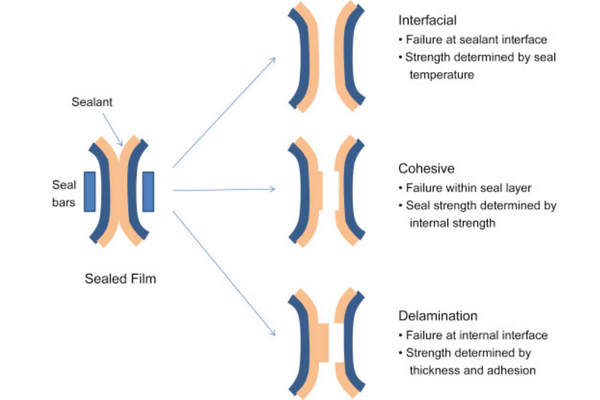
Diagram showing interfacial, cohesive, and delamination seal failures in flexible packaging films caused by temperature, strength, and adhesion differences.
Illustration explaining three major seal failure types—interfacial, cohesive, and delamination—caused by variations in material interfaces and sealing conditions.
Source: ScienceDirect – Seal Initiation Temperature

How to Detect Material Issues

SymptomLikely CauseFix
Layers peel apartUnder-cured adhesiveExtend curing time (48–72 hrs).
Sticky or uneven film surfaceExcess solvent residueAsk for solvent-free PU lamination.
Seal tears through the mid-layerThin sealant coatingRequire ≥18–25 g/m² PE coating.
Film curls during sealingUneven thicknessRequest QC data on film gauge tolerance.

Always test interlayer peel strength (ASTM F88 or F1140) before mass production. Reliable suppliers will provide test reports confirming bonding quality.


Step 5: Control Humidity and Logistics

Even the best seals can fail under poor storage and shipping conditions.

Aerial view of a cargo ship carrying colorful containers across the sea, illustrating the importance of packaging durability during ocean shipping.
A fully loaded cargo ship sailing across the ocean — poor packaging or weak seals during shipping can lead to product damage upon arrival.

During sea freight, containers can reach 50°C (122°F), and humidity spikes create “container rain.” These cycles weaken laminated films and soften polymer seals.

To prevent this:

  • Use thermal liners or insulation blankets for long-distance shipments.

  • Store films at 45–55% RH to avoid moisture absorption.

  • Include data loggers in containers to monitor temperature and humidity history.

This helps isolate whether seal failures stem from production or transport—a key step in supplier accountability.


Step 6: Work Smarter with Your Supplier

Weak seals are not just a factory issue—they’re a communication issue. The more details you provide to your supplier, the better your results will be.

What to include in your specification sheet:

  • Material structure (e.g., PET/AL/PE, Paper/PLA)

  • Total film thickness (µm)

  • Sealant coating weight (g/m²)

  • Sealing temperature range

  • Core size and roll width (for roll stock)

  • Storage humidity and testing method

Precise specifications turn your supplier relationship into a technical partnership—one based on measurable quality, not guesswork.


Conclusion

Weak tea pouch seals from China aren’t just a packaging issue—they’re a process issue. By mastering sealing temperature, controlling pressure, verifying film bonding, and improving communication with your supplier, you can eliminate costly failures and protect your product’s freshness, flavour, and reputation.

Get Your Own Packaging

Choose XLD's experts to perfect your packaging!

Koy Wang

Koy Wang

Flexible Packaging Specialist
B2B Sales Consultant

8+ years in flexible packaging, specializing in paper-based laminates and rollstock for tea, coffee, and food brands. Supported 50+ global clients on packaging performance, cost reduction, and FDA & EU compliance. Serving brands and co-packers across North America and Europe.

8yr+ Experience
50+ Global Clients
2 Markets
About the Author

Related articles

How to Choose the Right Tea Bag Wrapper Material for Different Packaging Machines?

Read More

Surging Oil Prices in 2026: How to Reduce Your Flexible Packaging Costs

Read More

How to Choose Compostable Food Packaging Without Compliance or Shelf-Life Risks?

Read More

How to Optimize Custom Printed Rollstock for VFFS Lines Without Causing Downtime?

Read More

Chat on WhatsApp

Contact Form