
The Definitive Guide to Tea Bag Sachet Packaging in 2026: Materials, Machinery, Compliance, and Sourcing Strategy
Key Takeaways
Tea bag sachet packaging is a three-layer engineered system — inner filter mesh, individual outer envelope, and carton — and the most consequential procurement decision tea brands will make in 2026. Here are the conclusions this guide supports with operational data:
The global tea bag market will grow from USD 7.83 billion in 2025 to USD 14.17 billion by 2034 (CAGR 6.82%), with pyramid sachets driving nearly all of the value expansion despite flat bags retaining higher unit volume.
PLA Soilon has replaced nylon as the dominant pyramid mesh material, but 2021–2025 research shows PLA still releases 1.3 to 14.7 billion micro- and nanoplastic particles per serving — meaning “biodegradable” alone is no longer a sufficient sustainability claim. Cellulose, abaca, and cotton muslin meshes are the only truly home-compostable options.
Material specification — not machine quality — causes roughly 80% of unplanned downtime on IMA, MAISA, and TEEPACK lines. The PLA thermal sealing window is ±3°C versus ±8°C for nylon, which is why first-pass yield on a poorly transitioned line drops from 96% to 82%.
Stable mainland China production has become the single most valuable supply chain asset for 2026, as Middle East shipping disruptions push alternative-route ocean transit times from 28 to 45–55 days with freight volatility above 60%. XLD Flex held 97.2% on-time delivery in Q4 2024 against peer manufacturers in Turkey and India dropping to 71%.
The 150-ton monthly output threshold separates trading-style suppliers from vertically integrated manufacturers with in-house printing, lamination, and slitting. Below this, lead times become unpredictable and quality traceability breaks down.
EU, US, and UK compliance now requires third-party migration test reports (SGS or Intertek), not just supplier-issued COAs. The EU PPWR entering force in 2026 will further restrict generic “compostable” and “biodegradable” labeling claims.
Central Asia (Russia, Kazakhstan), Africa (Kenya, Egypt), and pan-Asia represent the highest-growth premium sachet markets for 2026, driven by 22% domestic packaging capacity contraction in Russia, 11% annual tea import growth in Central Asia, and the structural cost erosion of European-domestic supply chains under sustained energy inflation.
For now, we have officially entered the second half of 2026. If you are still evaluating a 2026 sourcing strategy, the framework below covers the technical, regulatory, and commercial dimensions in the order they actually matter.
Why This Guide Exists
For tea brands and contract packers operating across North America, Europe, Australia, and the rapidly expanding markets of Central Asia and Africa, tea bag sachet packaging has stopped being a back-of-house procurement item. It is now a strategic decision that touches brand positioning, regulatory exposure, supply chain resilience, and gross margin in equal measure.
This guide consolidates what I have learned operating XLD Flex Packaging — a 30-person Chinese manufacturer producing 150 to 180 tons of tea bag tags, inner filters, and outer wrappers each month — into a single reference document for procurement managers, product directors, and CEOs evaluating their 2026 sourcing strategy. I have written it the way I would brief a buyer sitting across the conference table from me: no soft-pedaling, no marketing gloss, and with the same operational data points I use internally when our QC team flags a defective batch.
If you walk away with one principle, let it be this: in tea sachet packaging, specifying the right material is only one-third of the work; matching that material to your packing line and to your target market’s compliance regime is the other two-thirds. The brands that win in 2026 will be the ones who treat sachet packaging as an integrated engineering problem, not a line item.
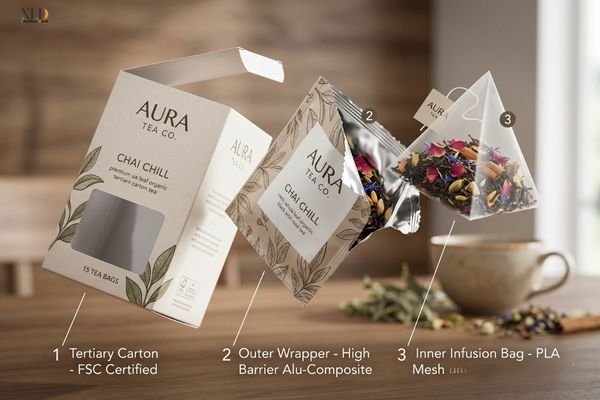
1. What Is Tea Bag Sachet Packaging? Anatomy of a Modern Three-Layer System
In industry usage, “tea bag sachet packaging” refers to the complete encapsulation system that takes loose tea from a blending hopper to a shelf-ready retail unit. It is not a single component. It is three nested layers, each engineered to solve a different problem, and each requiring distinct material specifications, machinery tolerances, and regulatory compliance.
The inner infusion bag — the layer in direct contact with hot water — is the structural and sensory heart of the product. This is where the choice between filter paper, nylon mesh, polylactic acid (PLA) Soilon, or cellulose nonwoven determines brewing performance, microplastic exposure, and the visual signal of premiumness. Flat double-chamber bags built from wood-pulp and abaca filter paper still dominate the commodity tier, while pyramid (tetrahedral) sachets built from PLA or nylon mesh have become the default for premium whole-leaf and herbal blends.
The individual outer envelope or wrapper — what most procurement managers actually mean when they say “sachet” — is the moisture and oxygen barrier that protects volatile aromatic compounds between the moment the bag leaves the packing line and the moment the consumer tears it open. Materials range from simple bleached kraft paper to paper/PE laminates to high-barrier paper/aluminum/PE composites with oxygen transmission rates below 0.5 cc/m²/24h.[^1]
The carton or display box is the tertiary layer, providing structural stacking strength, branding real estate, and shelf presence. Paperboard with 30–50% recycled content is now the baseline, but the carton itself has almost no barrier function — which is why the inner envelope’s lamination structure matters so much.
Sachet vs. Traditional Tea Bags: What’s the Difference?
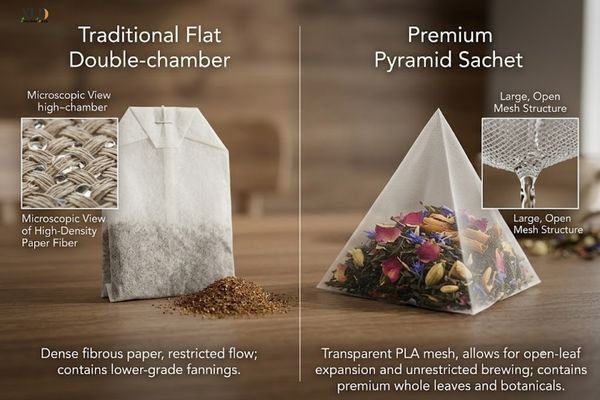
A traditional flat tea bag, mechanically pulverized and packed into a two-dimensional paper envelope, was engineered around a single objective: rapid extraction at the lowest possible cost per unit. The aggressive grinding into “fannings” or “dust” maximized surface area for color and caffeine release, but at the cost of volatilizing the delicate essential oils that give high-grade tea its complexity. The flat geometry also compresses the leaf matter into a dense, impermeable matrix during brewing, producing uneven extraction — astringent on the periphery, under-developed at the core.
The pyramid sachet inverts this compromise. By providing significantly greater internal volume relative to its surface area, the tetrahedral structure allows whole, unbroken leaves the physical space to unfurl and hydrate completely. Water circulates freely through the porous mesh, dissolving polyphenols, amino acids, and volatile organic compounds in a uniform osmotic exchange that closely replicates free-floating loose-leaf brewing. The format effectively encapsulates the spatial mechanics of a metal tea infuser inside a single-serve disposable unit.
The visual transparency of pyramid mesh also serves a commercial function. In an industry where most supermarket tea purchase decisions are made in under four seconds, the ability to display whole leaves, vibrant dried flowers, and identifiable spice fragments through the bag wall acts as a direct trust signal — a proxy that consumers read as “this is real tea, not dust.”
Why Premium Brands Are Shifting to Sachet Packaging in 2026
The global tea bag market is projected to grow from approximately USD 7.83 billion in 2025 to USD 14.17 billion by 2034, at a compound annual growth rate of 6.82%.[^2] But the growth is unevenly distributed: while flat paper bags retain the highest unit volume, the absolute value expansion is being driven almost entirely by pyramid sachets and premium private-label launches. Capital expenditure on automatic tea bag packaging machinery alone reached roughly USD 1.6 billion globally in 2026, expanding 6 to 7% per year.
Three forces are accelerating the shift. First, consumer willingness to pay a 4× to 8× unit price premium for visible whole-leaf product has been validated across mature markets. Second, the proliferation of functional and herbal blends — turmeric-ginger, ashwagandha, butterfly pea flower — favors the larger internal volume of pyramid bags over the constrained flat format. Third, the visual differentiation that pyramid sachets offer on shelf has become a defensive necessity for brands competing against private-label flat bags priced at USD 0.04–0.08 per unit.
Koy’s Take: From the XLD Flex order book, “tea bag sachet packaging” is the single most-misunderstood term in incoming RFQs. At least 30 to 40% of North American buyers use “sachet” interchangeably with “outer envelope,” which means the supplier is quoting against a different scope than the buyer is evaluating. Before you send your next RFQ, structure your specification in three explicit layers: (1) inner filter with material, mesh size, and bag style; (2) outer wrapper with lamination structure, barrier requirement, and printing method; (3) carton with board grade, finish, and SKU count per box. If your supplier cannot quote line-by-line against this three-layer breakdown, you are talking to a trader, not a manufacturer.
2. Core Materials for Tea Sachets: Engineering the Right Balance Between Brew, Barrier, and Biodegradability
Material selection in tea sachet packaging is a four-axis optimization problem: brewing performance, sealability on your specific machine, regulatory compliance in your target market, and the credibility of your sustainability claims. Optimizing one axis usually compromises another, which is why “use the most eco-friendly material available” is a slogan, not a procurement strategy.
2.1 Outer Wrapper Films: Plastic vs. Paper-Aluminum Composites
The outer envelope’s job is preserving aroma and protecting the inner bag from moisture, oxygen, and UV light during a shelf life that typically ranges from 18 to 24 months. The lamination structure determines whether your product still tastes like the blender’s intent on day 540.
Pure paper envelopes (60–80 gsm bleached kraft) are the lowest-cost option and dominate the European specialty tea segment, where shelf life is shorter and the tea is consumed faster. Oxygen transmission rates exceed 1,000 cc/m²/24h — essentially equivalent to no barrier at all — which means aroma loss begins within weeks.
Paper/PE laminates add a polyethylene heat-seal layer (typically 12–18 gsm) and bring OTR down to roughly 80–150 cc/m²/24h. This is the workhorse format for mid-tier brands.
Paper/aluminum/PE composites are the gold standard for premium positioning, achieving OTR below 0.5 cc/m²/24h and water vapor transmission rates below 1 g/m²/24h.[^3] The aluminum layer is typically 6.5 to 9 microns. The trade-off is recyclability: multi-laminate aluminum structures are not recyclable in most municipal streams, which puts them on a collision course with the EU’s Packaging and Packaging Waste Regulation (PPWR), entering force in stages from 2026 to 2030.
Metallized BOPP is a cheaper visual substitute for aluminum foil but offers significantly lower barrier performance and zero compostability.
2.2 The Rise of Sustainable Options: Paper-Based Degradable Materials
The fastest-growing category in 2026 is paper-based barrier films, in which a renewable cellulose substrate is bonded to a thin biodegradable barrier coating (typically PLA or a cellulosic film like NatureFlex). These structures achieve OTR between 0.03 and 0.06 cc per 100 square inches per 24 hours when properly laminated, approaching aluminum-foil performance while remaining industrially compostable.[^4]
Brands such as Twinings, Clipper, Bigelow, and Traditional Medicinals have transitioned all or part of their tea bag inventory to paper-based, plastic-free outer wrappers, citing both regulatory anticipation and direct retailer pressure. Twinings specifically uses a tea paper construction of wood pulp and abaca, sealed with a cotton string and a paper tag, and has achieved third-party home compostability certification under AS 5810 in Australia.
2.3 Inner Filter Materials: Nylon, PLA (Soilon), Cellulose, and Filter Paper
This is where most procurement decisions go wrong, and where the toxicological literature is most uncomfortable.
Filter paper (wood pulp + abaca, 12.5–17 gsm, heat-sealable) remains the lowest-cost option and dominates flat double-chamber production. It is partially biodegradable, food-safe, and runs reliably on every major flat-bag machine. Its limitations are visual — it is opaque, signaling “commodity” — and structural, since it cannot hold the three-dimensional pyramid geometry.
Nylon (polyamide) and PET monofilament mesh dominated the early premium pyramid market. Nylon offers a 215°C melting point, ~10% water absorption, exceptional transparency, and superior elasticity. PET woven mesh provides similar high-strength characteristics at slightly lower cost. Both are entirely non-biodegradable.
PLA Soilon (and proprietary variants like NeoSoilon) is now the dominant pyramid mesh material. Synthesized from corn or sugarcane starch through bacterial fermentation into lactic acid, PLA visually and mechanically mimics petroleum plastics. It has been certified for food contact in the United States, EU, Japan, and China, and complies with industrial compostability standards EN 13432, ISO 17088, and ASTM D6400.
Cellulose-based meshes (NatureFlex, hemp-cellulose hybrids) and natural-fiber alternatives like cotton muslin and abaca paper represent the truly home-compostable frontier. These materials degrade in standard ambient backyard compost conditions in approximately six months without requiring industrial heat or microbial inoculation.
The Microplastic Question Procurement Cannot Ignore Anymore
A 2019 study by McGill University’s Department of Chemical Engineering disrupted the perceived safety of premium tea packaging. Researchers emptied commercial nylon and PET pyramid bags, steeped the empty packaging in reverse osmosis water for five minutes at 95°C, and analyzed the leachate using scanning electron microscopy combined with FTIR and XPS spectroscopy. A single bag released approximately 11.6 billion microplastic particles and 3.1 billion nanoplastic particles into the cup — several orders of magnitude higher than the particle counts found in bottled water or other contaminated foods.[^5]
The popular response was a flight to PLA. The scientific response has been more nuanced. Subsequent analyses published between 2021 and 2025 demonstrated that PLA sachets shed between 1.3 billion and 14.7 billion micro- and nanoplastic particles per serving, depending on mechanical stress and filter pore size during analysis.[^9] Cellulose meshes have been measured releasing up to 170 billion particles per liter — numerically higher than synthetic polymers.
The critical distinction is biological persistence. Synthetic polymer particles remain structurally stable indefinitely and accumulate in human fatty tissue. Cellulose-derived particles, in contrast, are rapidly degraded by proteolytic enzyme complexes such as Morikrase, and in vitro testing on Caco-2 human epithelial cell lines has indicated no acute cytotoxicity. So the procurement question is not “does my packaging shed particles” (all of them do) but rather “what is the biological fate of those particles after ingestion.” This nuance is now appearing in retailer due-diligence questionnaires from Whole Foods, Sainsbury’s, and Rewe Group.
Koy’s Take: Here is an operational reality most suppliers will not volunteer. The thermal sealing window for PLA mesh is approximately ±3°C, while the window for nylon is ±8°C. When a customer asks us to switch the same IMA C24 line from nylon to PLA Soilon, first-pass yield drops from 96% to roughly 82–85% — unless we re-tune the ultrasonic horn power curve and the anvil pressure to match the new polymer behavior. In late 2024, we onboarded an Australian premium herbal brand transitioning from nylon pyramid to NeoSoilon. The first two production batches yielded 81%. We dropped the 35 kHz welder amplitude from 28 µm to 22 µm, replaced the standard horn with a titanium alloy horn rated for higher cycle counts, and recalibrated dwell time from 180 ms to 145 ms. Yield on batch three came back to 94%. The lesson: switching mesh material is never a procurement decision. It is a supply chain engineering decision, and your supplier needs to demonstrate they have done it before.
3. Packing Machine Compatibility: Why Material Specs Decide Whether Your IMA, MAISA, or TEEPACK Line Runs at Rated Speed
If your team has ever watched a USD 380,000 packing line throw an alarm every twelve minutes for an entire shift, you already know the punchline: machinery rarely fails because the machinery is broken. It fails because the consumable material drifted 4% outside its specification window and nobody on the procurement side was empowered to reject the inbound roll.
3.1 Material Specifications for IMA, MAISA, and TEEPACK Machines
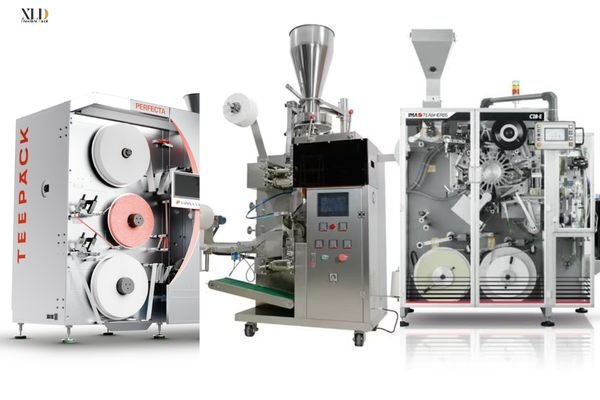
IMA C21 and C24 (double-chamber flat bag). These Italian machines are the global volume backbone for flat tea bags. The filter paper specification is non-negotiable: basis weight 12.5 to 17 gsm, tensile strength minimum 12 N/15mm in the machine direction, web tension tolerance ±2 N, and roll-width tolerance ±0.3 mm. Outer envelope paper for the in-line wrapper module should be 50 to 65 gsm with a controlled coefficient of friction (0.25 to 0.40) to prevent feed jams.
MAISA (Italy). The MAISA platform competes directly with IMA in the double-chamber flat segment and is particularly common in Eastern Europe and Latin American operations. MAISA machines are notoriously sensitive to filter paper moisture content — relative humidity variation greater than 6% between rolls causes seal-failure rates to spike. Suppliers shipping to MAISA users should condition rolls in a humidity-controlled warehouse at 50% ±5% RH for a minimum of 48 hours before dispatch.
TEEPACK Constanta and Perfecta (Germany). TEEPACK is the heritage choice for German, Dutch, and UK premium brands, with machines still in service from the 1980s alongside current-generation models. The Constanta runs heat-seal envelope paper with a tight thermal window — 145 to 165°C jaw temperature — and demands lamination structures that can survive 12 ms dwell without delamination. Perfecta integrates inner bag and outer envelope in a single frame, requiring synchronized material specifications across both rolls. TEEPACK customers need to verify that the paper/PE laminate’s PE seal layer has a melt flow index between 7 and 12 g/10min for reliable sealing at line speed.
Modern pyramid lines (Fuso FP-100s, Allpack APK-169, Yundu, Helper). Pyramid machines run at 30 to 80 bags per minute, hold dosing tolerance to ±0.2g, and use 30 to 35 kHz ultrasonic sealing instead of thermal conduction. The mesh roll specification tightens significantly: PLA Soilon at 17 to 21 gsm, basis weight tolerance ±5%, mesh opening 30 to 80 microns depending on tea cut, and longitudinal tension hold within ±1.5 N to prevent ultrasonic horn detuning.
3.2 Overcoming Common Sachet Packing Issues (Jamming, Sealing Failures, Dust Migration)
The four failure modes that account for roughly 80% of unplanned downtime on tea bag lines, in my experience:
Dust migration into the seal area. When filter paper porosity is too high or tea cut is too fine, fine particulate migrates to the seal interface during dosing. On thermal sealers this causes intermittent leak failures; on ultrasonic sealers the high-frequency vibration partially mitigates the problem, but residue still accumulates on the horn surface and degrades weld quality after 6 to 8 hours. Mitigation: specify filter paper with controlled porosity (Gurley value 18 to 28 seconds for fine cuts) and require the supplier to certify particle-shedding performance.
Ultrasonic horn fatigue and detuning. Titanium-alloy horns have a typical service life of 800 to 1,200 production hours before resonance drift exceeds tolerance. Operators who skip the scheduled horn frequency check (a 90-second test with a frequency analyzer) find themselves chasing intermittent seal failures across entire shifts.
Tag adhesive viscosity drift. Hot-melt adhesives applied to paper tags are temperature-sensitive: viscosity changes 8 to 12% per 5°C of nozzle temperature variation. Inadequate insulation around the glue pot during cold-month production is the single most common cause of tag detachment complaints from end consumers. (To address this issue, XLD has developed a unique self-adhesive tag to prevent such problems from occurring. Please contact our team for details.)
Web tension oscillation. As the parent roll diameter decreases, dancer-arm tension control must compensate dynamically. Cheap rewinders and improperly maintained tension brakes cause oscillations that translate directly into bag-length variation and intermittent jaw misregistration.
Why Production Stability Matters More in 2026 Than in Any Prior Year
There is a structural reality that procurement teams in Europe, the United States, and Australia are still under-pricing in their 2026 supplier scorecards: global ocean freight is no longer a stable input. Middle East shipping disruptions have driven sustained Red Sea route diversions around the Cape of Good Hope, and the resulting voyage extension has pushed Europe-to-Mideast and Europe-to-South-Asia transit times from approximately 28 days to 45–55 days, with freight rate volatility exceeding 60% in single quarters.
In that environment, stable, predictable production scheduling out of mainland China has become the single most valuable supply chain asset a tea brand can secure for 2026.
Koy’s Take: I will give you the number directly. XLD Flex’s on-time delivery rate in Q4 2024 held at 97.2%, with average lead times of 18 to 22 days landed at the US West Coast. In the same quarter, several of our peer manufacturers in Turkey and India saw OTD collapse to 71% — not because their factories were poorly run, but because their inbound raw material flows (Korean nylon mesh, Italian aluminum foil, German adhesive) were caught in the same routing chaos hitting everyone else. When your IMA or TEEPACK line stops for a single day waiting for filter paper, you do not just lose the cost of the materials and the labor. You lose your shelf facing at Whole Foods, Tesco, or Rewe — and the cost of recovering a lost facing is 8 to 10 times the cost of the original stockout. In 2026, “the machine can run” and “the machine will keep running” are two different procurement questions, and the second one is worth more than the first.
4. Compliance and Certifications for the US, UK, and EU Markets
Compliance is no longer a procurement afterthought. It is the gating requirement that determines whether your shipment clears customs, whether your product stays on shelf, and whether your brand survives the next retailer audit. The 2026 regulatory environment is materially stricter than what most buyers remember from their last sourcing cycle.
4.1 Food-Grade Safety: Meeting FDA 21 CFR 177 and EFSA Regulation (EC) No 1935/2004
In the United States, every polymer in direct food contact must comply with the relevant subsection of 21 CFR Part 177. For tea sachets specifically: nylon falls under 21 CFR 177.1500, polyolefins (PE, PP) fall under 21 CFR 177.1520, and resinous coatings (used in some paper laminations) fall under 21 CFR 175.300. PLA has historically been covered through Food Contact Notifications (FCN) issued to specific resin manufacturers — procurement teams should request the specific FCN number from their supplier.[^6]
In the European Union, Regulation (EC) No 1935/2004 establishes the general framework, while Commission Regulation (EU) No 10/2011 sets specific migration limits (SMLs) for individual substances in plastic food contact materials. Each plasticizer, antioxidant, or stabilizer has its own SML, and overall migration limit is capped at 10 mg/dm². Compliance is verified through migration testing under standardized food simulants — typically simulant E (95% ethanol) and simulant D2 (vegetable oil) for hot beverage applications.
The United Kingdom, post-Brexit, has retained substantively equivalent regulation but requires the UKCA marking in place of CE for relevant categories from 2023 onward. UK importers should specifically confirm their supplier’s awareness of the UKCA framework rather than assuming CE compliance carries over.
4.2 Why FSC, SMETA, and ISO 9001 Matter Beyond the Audit Checkmark
FSC (Forest Stewardship Council) certification on paper components is now functionally mandatory for major retailers including Whole Foods, Tesco, Sainsbury’s, Rewe, and Carrefour. The chain-of-custody requirement means every paper input — filter paper, outer envelope, carton, and tag — must trace to certified forests with documentation that survives a retailer audit.
SMETA (Sedex Members Ethical Trade Audit) is the four-pillar social compliance framework covering labor standards, health and safety, environmental performance, and business ethics. UK supermarket chains in particular treat SMETA 4-Pillar audits as a supplier-onboarding gate. The audit takes one to three days on site and must be repeated every two years.
ISO 9001 (quality management) and ISO 22000 (food safety management) constitute the baseline systems certifications. Mid-sized and large brands increasingly require both, and the absence of ISO 22000 specifically will block you from the larger UK and German retail chains. BRCGS Packaging Materials certification is the next tier above ISO 22000 and is becoming the de facto requirement for private-label work with US grocery majors.
4.3 The Microplastic Disclosure Pressure: What’s Coming in 2026–2027
The EU’s Packaging and Packaging Waste Regulation (PPWR), entering force in stages from 2026, will significantly tighten the rules around “compostable,” “biodegradable,” and “bio-based” labeling.[^10] Generic compostability claims will no longer be permitted; products must specify the qualifying disposal infrastructure (industrial composting, home composting) and reference the specific certification standard (EN 13432, AS 5810, etc.). Misleading claims are subject to product withdrawal and fines.
In parallel, the EU REACH framework has expanded its substances of very high concern (SVHC) list to cover several plasticizers and intentionally-added microplastics. While intentionally-added microplastics regulations primarily target cosmetics and detergents, the regulatory direction signals what is coming for food contact materials: mandatory disclosure of unintentionally released micro- and nanoplastic particle counts, beginning with infant food products and likely extending to hot-beverage formats by 2027–2028.
Koy’s Take: At XLD Flex, our standard practice for every food-contact batch is to attach a third-party migration test report from SGS or Intertek, typically costing USD 320–480 per batch, in addition to the supplier’s own Certificate of Analysis. Why? In 2023, a German customer of ours had a product pulled from Aldi shelves because the upstream PLA resin supplier had blended 6% recycled material into the virgin resin, causing antimony migration to exceed the SML. The customer absorbed a six-figure euro loss and lost shelf placement at Aldi for 14 months before reinstatement. Since that incident, every PLA and laminate batch leaving our facility carries a dual-COA plus third-party report system as a hard requirement. If your current supplier provides only their own COA without independent verification, I would strongly recommend you request a third-party migration test on your next shipment. The cost is trivial against the downside.
5. How to Source a Reliable Sachet Packaging Manufacturer in China (2026 Edition)
China remains the global volume center for tea bag inner filters, outer wrappers, tags, and rollstock films, with production concentrated in three provincial clusters: Zhejiang (approximately 58% of outer wrapper rollstock export volume), Guangdong (high-end laminated films and decorative cartons), and Fujian (filter paper and abaca-based natural fiber meshes). Sourcing intelligently from this base requires understanding three things: real production capacity, the strategic value of one-stop integration, and the rapidly shifting demand geography that will define 2026.
5.1 Evaluating Production Capacity (The 150-Ton Benchmark and Why It Matters)
The procurement question I see asked least often, and that matters most, is: what does this supplier actually produce in-house, and what do they outsource to subcontractors?
A monthly production capacity of approximately 150 tons of tea bag-related output is the practical threshold separating a “trading-style” supplier from a vertically integrated manufacturer. Below that volume, suppliers typically rely on external printing, lamination, and slitting subcontractors, which means: (1) lead times stretch unpredictably during peak demand seasons; (2) batch-to-batch consistency suffers because the upstream subcontractor’s process drift is invisible to the nominal supplier; (3) traceability through a quality investigation requires four to six weeks instead of 48 hours.
Above the 150-ton threshold, suppliers generally operate their own gravure or flexo printing presses, dry/solventless lamination lines, and slitting/rewinding stations under one roof. This vertical integration is what makes 18 to 22-day total lead time achievable from order confirmation to FOB shipment.
When evaluating a Chinese supplier in 2026, ask for the following operational data and rule out anyone who cannot answer in writing within 48 hours:
Monthly output by category (filter paper, outer wrapper, tag, rollstock) for the past 6 months
In-house equipment list with serial numbers and year of installation
Average first-pass QC yield by product line for the past 6 months
Customer concentration (no single customer should exceed 35% of revenue — above this and you become a hostage to that customer’s order calendar)
ISO 9001 + ISO 22000 + BRCGS or FSSC 22000 certificates with valid dates
The most recent SMETA 4-Pillar audit report (if your retailer requires it)
5.2 The Value of a One-Stop Supplier (From Tags to Outer Wrappers to DDP Logistics)
The procurement convenience of sourcing tags from one supplier, filter paper from another, outer wrappers from a third, and cartons from a fourth is illusory once you trace the total cost properly. Three structural advantages favor consolidating with a single integrated manufacturer:
Tonnage-based pricing leverage. When a single supplier handles all four components for your SKU portfolio, they aggregate your annual tonnage into a single negotiating block. The unit price compression on a USD 280,000 annual spend distributed across four suppliers vs. consolidated with one is typically 6–11%, which often exceeds the margin contribution of the entire SKU.
Formulation consistency across batches. When the same factory controls tag adhesive, filter paper coating, and outer envelope laminate, color matching across the three components stays within ΔE < 1.5 across an entire production year. Splitting suppliers introduces ΔE variance of 2.5 to 4.0, which retail buyers notice and which forces premature inventory turnover.
Single-point traceability and accountability. When a quality issue surfaces at a retailer, the diagnostic chain runs from the consumer complaint to the lot number to the production batch to the raw material certificate — within 48 hours when one supplier owns the whole chain, and not at all reliably when four suppliers are involved.
For brands operating with lean supply chain teams, the one-stop model also extends naturally to door-to-door logistics, with the manufacturer managing customs clearance, ocean booking, and DDP delivery to the brand’s distribution center. Our internal data shows door-to-door consolidation reduces total landed lead time variability from a 9-day standard deviation to a 3-day standard deviation.[^7]
If you want to see how this integration translates into specific service tiers, we have published a detailed breakdown in our
Tea packaging material selection hub.
5.3 The Emerging Markets Lens: Why Asia, Russia, Kazakhstan, and Africa Are 2026’s New Growth Frontiers
I want to close this section with a structural observation that I think is the most under-discussed shift in global packaging in 2026: the packaging market overall is still growing, but the geographic center of demand is moving east and south at a pace most European and North American sourcing teams have not yet fully internalized.
Two forces are driving this.
First, the long-tail effects of Europe’s energy crisis are systematically eroding the cost competitiveness of European-domestic packaging supply chains. German BOPP film manufacturers saw electricity costs rise from approximately €0.08/kWh in 2021 to €0.21/kWh by 2024. Italian gravure printers have widened color-registration tolerance from ±0.1 mm to ±0.2 mm specifically to reduce scrap rates against a higher energy cost base. The cumulative effect is that UK, German, and Dutch tea brands that historically sourced “near-shore” within Europe are now actively re-evaluating Asian sources for 2026 — not for the lowest price, but for delivered cost stability.
Second, rising global fertilizer costs are reshaping both tea cultivation patterns and packaging demand in emerging markets. Russia and Kazakhstan have seen domestic packaging capacity contract by approximately 22% since 2022, while their tea import volumes have grown at 11% annually — creating a structural supply gap that they cannot fill domestically. African tea-producing economies, particularly Kenya and Egypt, are scaling tea garden output but lack local high-specification sachet packaging capacity at the volume required.[^8]
Koy’s Take: Roughly 70% of XLD Flex’s new Central Asian customers in late 2024 came from existing supply relationships in Turkey or the UAE that had become unreliable. Their priority list, in order, was strikingly different from our European customers: (1) third-party migration test reports they could show to local food safety authorities; (2) in-house 8-color printing capability with Russian and Kazakh language support; (3) acceptance of LC at 60 days as the payment instrument. Notice that “lowest price” is not on the list. These are sophisticated buyers operating in a market that has been forcibly re-routed away from its historical European supply base and toward Asia. For any China-based manufacturer paying attention, this is the most coherent growth opportunity I have seen since the 2018 pivot to functional teas. For any Western brand thinking about market expansion, Central Asia and parts of Africa are markedly under-served at the premium sachet tier, and the brand that establishes shelf presence in 2026 will have a 3–5 year head start over competitors still focused exclusively on Whole Foods and Tesco.
If you want to discuss specific RFQ structures for these markets, you can reach me directly at koywang@xldflex.com or browse our full capability set at xldflex.com.
6. Frequently Asked Questions About Tea Sachet Packaging
What is the standard size for a tea bag sachet?
For flat double-chamber bags, the global standard is approximately 60 × 50 mm with a 1.5 to 3.0 g fill weight, optimized for IMA C21/C24 and equivalent platforms. For pyramid sachets, the dominant size is 65 × 65 mm × 65 mm (face-edge dimension) with a 2.0 to 3.5 g fill weight, suitable for whole-leaf and herbal blends. Custom sizes outside these ranges are achievable but typically require tooling adjustment, a one-time engineering charge of USD 800 to USD 2,500, and minimum order quantities 30 to 50% higher than standard sizes.
Can sachet packaging be fully compostable?
Yes, but with critical conditions. A fully home-compostable tea sachet system requires four components to all be home-compostable: the inner mesh (cellulose, NatureFlex, abaca, or cotton muslin), the string (cotton or paper thread), the tag (uncoated paper with water-based ink), and the outer envelope (paper-based with cellulosic barrier coating, no aluminum, no PE). Full home compostability under AS 5810 (Australia) or TÜV OK Compost HOME certification is achievable, but production cost is typically 35–55% higher than a conventional PLA + paper/PE laminate system. Industrial-compostable systems using PLA throughout are less expensive but require commercial composting infrastructure that most consumer markets lack.
How much does custom printed sachet packaging cost?
Pricing varies by component, volume, and complexity, but as 2026 reference points: outer envelope rollstock with 4-color flexo printing runs approximately USD 5.20 to USD 8.40 per kg at 5-ton MOQ; PLA Soilon mesh runs approximately USD 11 to USD 15 per kg; filter paper runs approximately USD 3.80 to USD 5.50 per kg. Tooling and plate costs are typically USD 200 to USD 600 per color per SKU. A complete custom-printed sachet program (inner + outer + tag + carton) for a 1-million-bag launch typically lands at USD 0.012 to USD 0.028 per bag landed FOB, depending on barrier specification and substrate choice.
What is the MOQ for custom tea bag sachet packaging?
Standard industry MOQ for custom-printed outer envelope rollstock is 3,000 to 5,000 kg per SKU, equivalent to roughly 1.2 to 2.0 million envelopes. PLA mesh MOQ runs approximately 2,000 kg per SKU. Tags can be produced at lower MOQs (50,000 to 100,000 pieces). At XLD Flex, we offer split-MOQ programs for new brand launches that bring effective combined MOQs down to roughly 500,000 envelopes plus 200 kg of mesh, which makes initial market validation considerably more feasible for emerging brands.
Are PLA tea bags safe for hot water brewing?
PLA is certified food-safe by the FDA, EFSA, and equivalent agencies in Japan and China, and as an inert biopolymer it does not leak phthalate or BPA-style plasticizers. However, the 2019 McGill study and subsequent 2021–2025 follow-up research demonstrate that PLA mesh, like nylon and cellulose meshes, releases billions of micro- and nanoplastic particles per serving during hot water brewing. Acute cytotoxicity testing on these particles has so far been negative, but long-term ingestion data is not yet established. Brands wanting to fully eliminate microplastic exposure should specify cellulose, abaca, or cotton muslin mesh rather than PLA.
Closing: The Procurement Decision That Compounds for the Next Five Years
Tea bag sachet packaging in 2026 is not a procurement category where “good enough” wins. The combination of regulatory tightening (PPWR, PFAS restrictions, microplastic disclosure), shipping route instability, energy cost dispersion, and the rapid migration of premium demand into Central Asia and Africa means that the supplier you select this year will define your cost structure, your shelf placement durability, and your ability to claim sustainability credentials credibly through 2030.
The framework I have laid out — three-layer system thinking on the technical side, third-party verified compliance on the regulatory side, and 150-ton vertically integrated capacity on the sourcing side — is not the only way to evaluate suppliers. But it is the framework that has held up across 11 years of operating XLD Flex through three major industry shifts: the 2017 PLA transition, the 2020–2022 supply chain shock, and the 2024–2026 routing realignment.
If you would like to walk through your specific SKU portfolio against this framework, request third-party migration reports on your current inventory, or discuss a 2026 supplier diversification strategy that hedges against further freight volatility, I am directly reachable at koywang@xldflex.com. You can also explore our full production capability and request samples at xldflex.com.
The brands that will dominate tea retail shelves in 2030 are making their supplier decisions in 2026. I hope this guide helps yours be the right one.
— Koy Wang, Packaging Innovator, XLD Flex Packaging
References
[^1]: Smithers, The Future of Flexible Packaging to 2028 (2024). Multi-laminate paper/aluminum/PE structures achieve OTR < 0.5 cc/m²/24h and WVTR < 1 g/m²/24h. https://www.smithers.com/services/market-reports/packaging
[^2]: Future Market Insights, Tea Packing Machine Market Outlook 2025–2034 (2025). https://www.futuremarketinsights.com/reports/tea-packing-machine-market
[^3]: Mondi Group, Barrier Paper Technical Data Sheets — FunctionalBarrier Paper Range (2024). https://www.mondigroup.com/en/products-and-solutions/
[^4]: Futamura Chemical, NatureFlex Compostable Films — Technical Specifications NM30 (2024). Oxygen transmission rate 0.03–0.06 cc/100sq.in./24h. https://www.futamuragroup.com/divisions/cellulose-films/
[^5]: Hernandez, L. M., Xu, E. G., Larsson, H. C. E., Tahara, R., Maisuria, V. B., & Tufenkji, N. (2019). Plastic Teabags Release Billions of Microparticles and Nanoparticles into Tea. Environmental Science & Technology, 53(21), 12300–12310. https://pubs.acs.org/doi/10.1021/acs.est.9b02540
[^6]: U.S. Food and Drug Administration, Inventory of Effective Food Contact Substance Notifications (continuously updated). https://www.fda.gov/food/food-ingredients-packaging/inventory-effective-food-contact-substance-fcs-notifications
[^7]: XLD Flex Packaging internal operations data, Q1 2024 – Q3 2025. Door-to-door consolidated logistics reduced lead time standard deviation from 9 days (multi-supplier) to 3 days (single integrated supplier). Internal report available on request.
[^8]: International Trade Centre (ITC) Trade Map, Tea (HS 0902) Import Statistics by Country (2024); FAO Statistical Yearbook 2025, World Tea Production and Trade. https://www.trademap.org / https://www.fao.org/statistics/
[^9]: Banaei, G., et al. (2023). Bioplastic teabag releases micro and nanoplastic particles after digestion. Chemosphere, 343, 140196. https://www.sciencedirect.com/science/article/abs/pii/S0045653523023342
[^10]: European Commission, Regulation (EU) 2025/40 on Packaging and Packaging Waste (PPWR), entering force in stages from February 2026. https://eur-lex.europa.eu/eli/reg/2025/40/oj