
How to Choose Recyclable Coffee Packaging Without Compromising Freshness or Compliance?
I’m frequently asked by roaster clients how they should switch to recyclable coffee packaging. They don’t want to face issues like leaks, diluted flavor, and retailer boycotts after changing their packaging.
My principle for choosing recyclable coffee packaging is: first, determine your actual shelf-life goals; second, match it to the recyclable infrastructure your market can actually handle; and finally, ensure food contact and labelling compliance before production. Following this process ensures coffee freshness and reduces compliance risks.
If you have similar concerns, this article can save you time, avoid repeated redesigns, and prevent you from paying for “recyclable” packaging that fails as soon as it enters the distribution channel.
1. Why Many “Recyclable” Coffee Packages Fail in Real-World Use?
I have seen “recyclable” bags look perfect in a sample box, then fail on a filling line or in humid shipping. That gap is where most projects go wrong.
When I audit failed recyclable coffee packaging, the issue is rarely the word “recyclable.” It is usually a weak barrier plan, the wrong valve or zipper family, or sealing settings that were never tuned for a mono-material film. Real-world use exposes these fast.
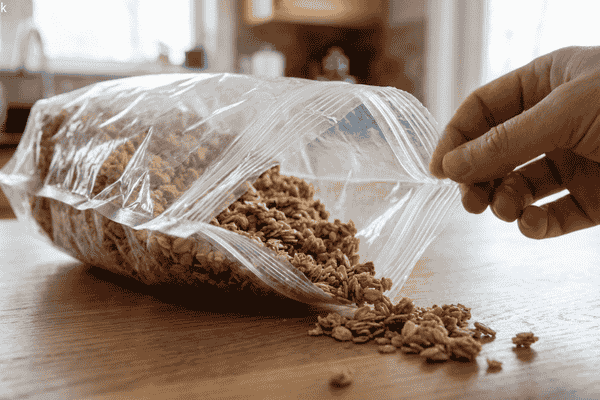
Three most common failures I see
1) Barrier looks fine on paper, then falls apart in real humidity
The main reason coffee spoils is oxygen and moisture penetrating the packaging. Many teams compare only the “best case” barrier numbers. They test at easy lab conditions and stop there. This isn’t necessarily a mistake, but real-world conditions can be far more complex than in a lab.
- Oxygen can rise in the bag headspace faster than expected.
- Moisture can creep in during ocean freight or hot warehouses.
- Light can speed up flavor loss if the pack is too clear and lightly printed.
If the roaster primarily sells locally and has a fast inventory turnover, medium or even low barrier performance may be sufficient. But if the roaster needs to ship across climates or sell online, “good enough” barrier performance may become “not enough” within two weeks.
2) “Recyclable film” is chosen, but the parts break the claim
A bag is not just film. It is film + valve + zipper + ink + adhesive + label. One wrong part can ruin the recycling story.
Common mistakes:
- A standard mixed-material degassing valve on a mono-material bag.
- A zipper made from a different polymer family than the pouch.
- Heavy inks make sorting harder in some recycling systems.
In my opinion, this stems from a lack of careful consideration of the packaging. If the bag is “all-PE,” then the valve and zipper need to be “PE-compatible” too, not “usable.”
3) Sealing is not re-qualified for the new structure
A recyclable structure can seal in a different temperature window. It can also behave differently under pressure and dwell time.
I see failures like:
- “Good seal strength” in slow hand tests, but seal peel in high-speed runs.
- Bottom seal opens during drop because hot tack is too low.
- Cosmetic burn-through because the outer layer is also PE and softens sooner.
This is why I never treat a film switch as only a material switch. It is also a process switch.
A simple table I use to diagnose the problem fast
| What failed in the market | What it usually means | What I check first | Simple fix direction |
|---|---|---|---|
| Coffee tastes flat early | Oxygen ingress is higher than planned | OTR target vs. real distribution time | Upgrade barrier layer or coating, add nitrogen flush control |
| Bag feels soft or beans clump | Moisture ingress is too high | WVTR at high humidity | Add moisture barrier plan, improve seal quality, review storage |
| Bag puffs or bursts | CO₂ is trapped | Valve spec and placement | Switch to mono-material valve and validate vent rate |
| Seals split on the line | Hot tack or seal window mismatch | Seal temp, dwell, pressure | Re-tune settings, use higher hot-tack sealant, add cooling time |
| Retailer rejects “recyclable” claim | Claim is not accepted locally | Label rules and access threshold | Use clear disposal label and region-specific claim language |
The “real-world” test plan I ask for before mass production
I keep it simple and practical:
- Line trial: run at target speed with real coffee weight, not empty packs.
- Drop and squeeze test: simulate shipping and handling.
- Short shelf check: store samples in warm and humid conditions and taste at set dates.
- Claim check: confirm the disposal message matches the market (curbside, store drop-off, or specialty collection).
When teams do these four steps early, the “surprise failures” almost disappear.
2. Mono-material vs. Paper-Based Recyclable Structures: Which One Fits Your Market and Coffee Type?
I often hear “paper is greener,” then I see the same brand add more plastic later because the coffee goes stale. I prefer choosing by fit, not by trend.
I choose between mono-material and paper-based recyclable coffee packaging by matching the local recycling path and the shelf-life need. If the market can collect and recycle flexible PE or PP well, mono-material wins for performance. If the market pushes fiber recycling and the coffee turns fast, a paper-based structure can work with the right liner. After all, the original purpose of packaging is to protect the product.
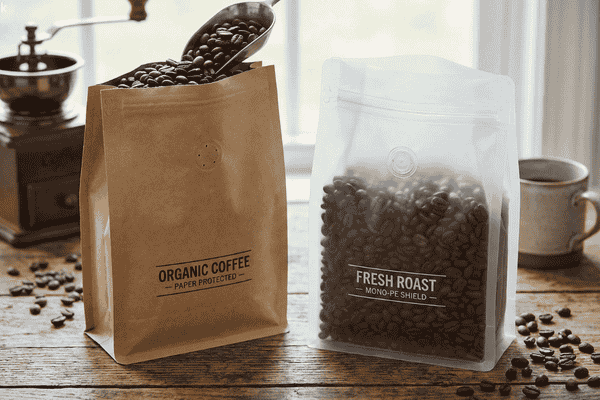
First, I map the disposal path, not the marketing claim
If the market is flexible-plastic friendly
Mono-material packaging is usually a safer technical option. It can deliver strong seals, stable barrier, and consistent machine performance.
Two common routes:
- All-PE recycle-ready coffee bags (often MDO-PE outside + PE sealant + a thin barrier layer)
- All-PP recycle-ready coffee bags (common in areas with high PP recycling rates, such as Belgium and Latvia)
But “friendly” still needs proof. In North America, labeling programs often use access thresholds. For example, For example, How2Recycle’s “widely recyclable” concept is linked to the broad acceptance of its recycling program, meaning that most communities accept it, and consumers can simply drop it into curbside recycling bins. (How2Recycle)
The actual situation must be considered in conjunction with local policies and public acceptance.
If the market is fiber-first
Paper can be a good front story. It can also be a good feel in hand. Still, paper alone does not protect roasted coffee well.
So paper-based recyclable structures often look like:
- Paper outside for feel and branding
- A thin recyclable liner inside for sealing and barrier
- Controlled ink and adhesive choices
This can work well for:
- Fast-moving retail coffee
- Local distribution
- Brands that want the “paper look” but still need basic protection
Second, I match structure to coffee type and sales channel
Whole bean vs. ground coffee
Ground coffee is more sensitive because it has more surface area. It can stale faster. That often pushes the decision toward higher barrier.
Local retail vs. export vs. e-commerce
- Local retail: moderate barrier may be fine if turnover is fast.
- Export and e-commerce: the pack must handle climate swings and longer storage, so barrier and sealing must be stronger.
The table I use to choose a direction in 5 minutes
| Decision factor | Mono-material (PE/PP) | Paper-based recyclable structure |
|---|---|---|
| Best for long shelf-life | Strong option when paired with barrier tech | Harder, unless liner is well designed |
| Seal reliability on machines | Usually strong after tuning | Can vary due to paper stiffness and liner design |
| “Feel” and shelf impact | Modern and clean | Natural and premium feel for many buyers |
| Recycling message | Depends on local flexible collection | Often easier to explain if fiber pathway is strong |
| Risk of greenwashing claims | Lower if disposal path is real | Higher if paper cannot be recycled due to coatings/liners |
A practical note on “coatings” that improve single-layer PE
Single-layer PE is recyclable, but its barrier can be weak compared with older foil laminates. I often improve it by using a thin coating that boosts protection without turning it into a mixed-material headache.
Two types I see used in the market:
- Water- and oil-resistant coatings that support performance and handling
- Barrier coatings that reduce oxygen and moisture movement
Equipment and chemistry partners like BOBST (application systems) and Michelman (coating solutions) are often referenced in this space because coatings can lift performance while keeping the structure closer to a mono-material recycling story.
I do not treat coatings as magic. I treat them as tools. They work when the coating is thin, stable, and validated under real conditions.
If you’re interested in our solutions, please visit our Tea & Coffee Marketing Solutions for more details, or click “Contact” in the right corner to connect with our professional team directly.
3. What to Verify Before Switching to Recyclable Coffee Packaging at Scale?
Some brand clients rushed to place orders, only to later contact me and report discovering that large quantities of packaging bags were incompatible with machine sealing, failed to seal properly after filling with products, or even resulted in suppliers failing to deliver—causing significant losses. I emphasize that large-scale packaging conversions require solid evidence, not luck.
Before fully adopting recyclable coffee packaging, I recommend verifying the following five key points:
- Barrier performance under relevant humidity conditions
- Compatibility of all components (film, valve, zipper, ink)
- Sealing window capability on production lines at target speeds
- Disposal methods approved by local consumer markets
- Compliance documentation for food contact and restricted chemicals
Any missing element will be considered a risk and warrant the suspension of related operations.
Verification step 1: Barrier targets that match your real supply chain
I start with two simple metrics:
- OTR (oxygen transmission rate): lower usually means longer aroma life
- WVTR (water vapor transmission rate): lower usually means better resistance in humid storage
I not only accept data sheets but also require the provision of test methods and conditions. Given that transportation and storage conditions may not be ideal, I simultaneously request “simulated container transport” testing.
Verification step 2: The whole pack is designed as one recycling system
I confirm:
- Valve polymer family matches the bag’s family
- Zippers match the family
- Labels, inks, and adhesives do not create sorting or reprocessing issues
This matters because recyclability is judged on the whole pack, not the base film alone.
Verification step 3: Sealing window and hot tack on the real machine
I want:
- Target speed trial
- Seal strength checks over a temperature range
- Drop tests after sealing
- A plan for cooling time if needed
If seals are not stable, the best sustainability story does not matter. Customers do not forgive leaks.
However, this often requires client cooperation—we must confirm with customers and arrange sample testing whenever possible. After all, suppliers may not always possess suitable testing facilities.
Verification step 4: The disposal claim matches the market reality
This is where brands get burned. A bag can be “technically recyclable” and still not be accepted in the main collection path.
I do a simple check:
- What do retailers accept?
- What do local programs collect?
- What label language is allowed?
For example, uses acceptance thresholds to classify recyclability access. (How2Recycle)
Verification step 5: Compliance dossier for the markets you sell into
I keep the dossier clean and simple:
- Food-contact compliance documents for the target region
- Migration or safety testing where needed
- Statements on restricted substances
- Clear traceability for materials and additives
For the EU, the PPWR introduces key timelines that can affect packaging choices. It establishes recyclability performance grades from 2030 and tighter obligations from 2038. (EUR-Lex)
It also includes a compostability requirement for certain packaging formats from 12 February 2028. (European Bioplastics e.V.)
It introduces PFAS restrictions for food-contact packaging effective 12 August 2026, with specific thresholds. (Anthesis)
The scale-readiness checklist I give to buyers and roasters
| What I verify | What “good” looks like | What I ask the supplier to provide |
|---|---|---|
| Barrier plan | OTR/WVTR fits the real shelf-life and climate | Test report, method, and conditions |
| Pack system | Film + valve + zipper are compatible | BOM list and material statement |
| Line performance | Stable seals at target speed | Trial notes, seal curve, sample packs |
| Disposal claim | Matches local collection and retailer rules | Label guidance and region notes |
| Compliance | Complete and current for your markets | Food-contact docs, restricted substance statement |
A simple way to reduce risk without slowing the project
If a brand wants speed, I do a phased approach:
- Pilot run with one SKU and one channel
- Monitor complaints and returns
- Expand once failure rate stays low
This keeps the switch safe. It also protects the brand’s reviews, which can be harder to repair than a bag design.
Conclusion
2026 is a “transition year” demanding practicality and environmental friendliness. When choosing recyclable coffee packaging, we priorities four factors: barrier properties, airtightness, manageability, and compliance. When these factors align with actual usage, both freshness and recyclability can be achieved.