
The Ultimate Sustainable Flexible Packaging Materials List for 2025
If you’re searching for a sustainable flexible packaging materials list for 2025, you’re probably stuck between two pressures: customers want “greener” packaging, and your operations team still needs shelf life, line speed, and stable pricing.
You’re not alone. Most buyers I speak with are doing small pilots, not full conversions, because the risk of product spoilage, claims audits, and supply instability is real—especially when sourcing from China.
This guide helps you compare the materials actually being adopted in 2025, where they work, where they fall short, and what you should ask your supplier before approving a trial order.
Sustainable materials list 2025: what buyers should shortlist first
| Material route (2025 reality) | What it replaces | Best-fit products | Biggest risk if sourced from China | Buyer “must ask” |
|---|---|---|---|---|
| Recyclable mono-PE (incl. MDO-PE + PE sealant) | PET/PE, OPP/PE laminates | Dry food, frozen, many personal care | “Mono” claim but hidden incompatible layers; poor stiffness for shelf display | “% PE by weight? Barrier layer type and %? Any recyclability guidance used (APR/How2Recycle)?” (plasticsrecycling.org) |
| Recyclable mono-PP (retort-capable variants) | Foil laminates in some cases | Retort/hot-fill, some pet food | Retort performance gaps; seal failures after sterilization | “Retort condition proof? Seal strength before/after retort? Curl/warpage data?” |
| PCR-enabled films (mass balance / mechanically recycled where allowed) | Virgin PE/PP/PET | Secondary packs, some food (case-by-case) | Odor, contamination, migration risk; inconsistent PCR supply | “Food-contact pathway (FDA/EFSA)? COA per lot? Odor/migration test plan?” (U.S. Food and Drug Administration) |
| Functional barrier paper (recyclable paper stream) | Multi-layer high-barrier | Coffee/tea, powders, dry mixes, some snacks | Coating not recyclable in practice; sealing instability on high-speed lines | “Recyclability test method? OTR/WVTR targets? Heat-seal window?” (Mondi Group) |
Therefore, by 2025, the discussion about “environmentally friendly flexible packaging materials” will no longer be about choosing a “magic” material. We will focus more on demonstrating the end-of-life disposal, performance, and compliance of various materials.
Recyclable Mono-Material Solutions: PE and PP Breakthroughs
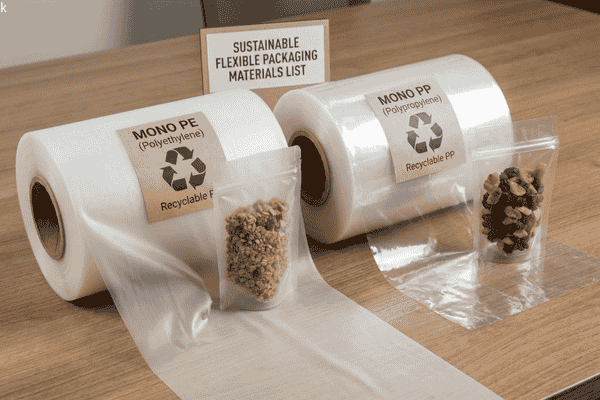
Mono-material is the fastest path to “recyclable” claims in both the EU and parts of North America—but only when the structure follows design rules and local collection exists. In the EU, the Packaging and Packaging Waste Regulation (PPWR) entered into force in February 2025 and aims to design packaging for recycling (with the well-known 2030 direction). (Environment)
In North America, “store drop-off” style programs and design guides push buyers toward PE/PP-dominant structures. (How2Recycle)
What’s actually improved in 2025
- MDO-PE / BOPE-style stiffness upgrades: makes mono-PE look more like PET/PE on the shelf.
- Thin barrier options (used carefully): EVOH at low percentages or ultra-thin coatings can reduce oxygen ingress while staying “recycle-friendly” per guidance documents.
- Mono-PP for heat: PP is used when PE softens too early (hot-fill/retort scenarios).
A Simple and Feasible Plan for Buyers:
Step 1 — Demand the “composition proof.”
Ask for a breakdown of the structure by weight (not just layer names). Many “mono” pouches fail audits because they are 70–80% PE with a meaningful PET/PA layer.
Step 2 — Ask for the recyclability rulebook they designed.
- “Which guidance did you see as the target—APR PE/PP film guidance or How2Recycle store drop-off guidance?”
- “Do you have any third-party recyclability assessment or test summary?”
Step 3 — Run a short trial with the right acceptance tests.
Use a trial protocol (not just “looks good”):
- seal window (temp/pressure/dwell)
- drop test + flex crack check
- OTR/WVTR vs your shelf-life requirement
- machinability at target line speed
What to ask a China supplier?
| Topic | Questions that uncover real risk |
|---|---|
| Mono-material claim | “What % of the pack is PE or PP by weight? Any PA/PET/Al foil? Any metallization?” |
| Barrier | “What is the barrier layer (EVOH/coating)? What %? Where is it placed (core layer)?” |
| Label/ink | “Are inks/adhesives compatible with PE/PP recycling guidance? Any test history?” |
| Production control | “How is the impact of raw material batch changes controlled? Can the source of raw materials for the entire purchase order be locked in??” |
Incorporating PCR (Post-Consumer Recycled) Content into Flexible Films
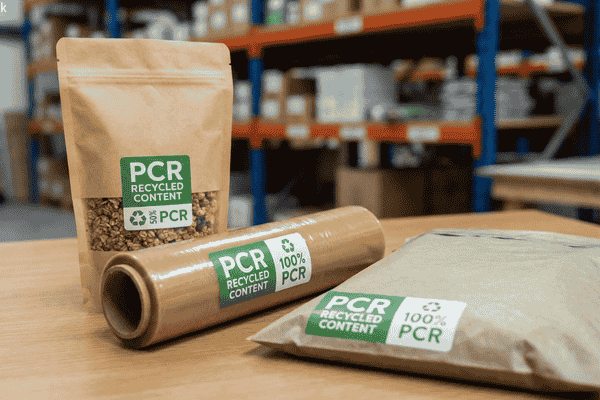
PCR is where sustainability talk turns into compliance and liability. The hard truth: food-contact PCR is not a simple “add 30%” decision.
In the US, the FDA evaluates recycled plastics for food packaging case-by-case and issues opinions (commonly referenced through its recycled plastics program and supporting guidance). (U.S. Food and Drug Administration)
In the EU, food-contact recycled plastics are regulated and linked to assessed recycling processes. (Food Safety)
Meanwhile, due to the aforementioned reasons, it is difficult to export flexible film containing PCR manufactured in China, and these products have complex origins and are hard to find on the market.
Why PCR causes problems in flexible films
- Odor + contamination risk (especially for recycled polyolefins)
- Color drift and gel risk (film defects)
- Supply instability (food-grade PCR is constrained)
- Documentation gaps when sourcing cross-border (what’s “food-grade” in one market may not satisfy your auditor)
Practical PCR decision matrix (buyer-side)
| Your product reality | PCR approach that usually works | What often fails | What you should request |
|---|---|---|---|
| Dry goods, low odor sensitivity | Low-PCR outer layer or secondary pack | High-PCR in inner sealant | Odor panel data + COA per lot |
| Fatty/aromatic foods | Case-by-case; often limited without strong compliance path | “Generic PCR” without clear food-contact basis | Regulatory pathway explanation + migration plan (U.S. Food and Drug Administration) |
| E-commerce / secondary packaging | Higher PCR possible | Overpromising “food-grade” | Mechanical properties trend data over 3 lots |
| Medical / sensitive applications | Very controlled, often minimal PCR | Unverified PCR sources | Traceability + strict lot locking |
While we are not currently able to provide packaging containing PCR materials, you can contact us if you need packaging for tea, powder, or aroma-sensitive products—see tea packaging materials.
To avoid costly mistakes, buyers must understand these questions:
- “Is this PCR mechanical or chemical route, and what evidence supports food-contact use in my market?” (U.S. Food and Drug Administration)
- “Can you supply the same PCR source for 3–6 months, or will the feedstock change every order?”
- “What is your odor control plan (deodorization, purge, testing)?”
Innovative Bio-Based Polymers: Reducing Reliance on Fossil Fuels
Bio-based polymers sound simple—”plant-based equals better”—but both buyers and consumers suffer if buyers confuse bio-based with compostable, or if local infrastructure can’t handle the end-of-life processes for used packaging.
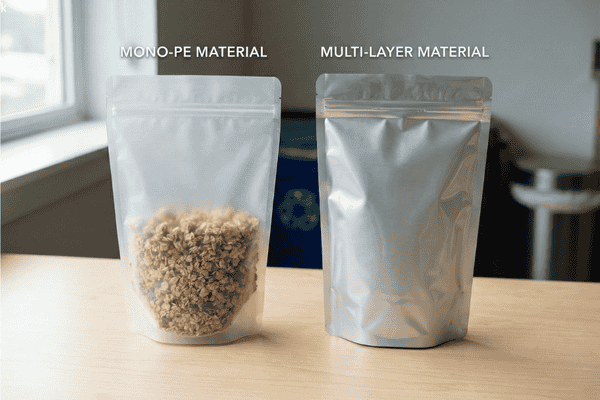
Furthermore, during market downturns, many brands only conduct small-batch pilot production—as you can see: MONO-material packaging is increasing in 2025, but multi-layer composites still dominate the daily market because economic benefits and shelf-life risks don’t disappear overnight.
Bio-based options buyers actually use (and why)
| Bio-based route | What buyers like | Where it breaks | China sourcing risk to watch |
|---|---|---|---|
| Bio-PE (drop-in polyethylene) | Same equipment, same recycling stream in theory | End-of-life still depends on PE collection | “Bio-based %” claims without credible certification |
| PLA / PBAT blends (industrial compostable direction) | Good for specific use cases | Heat sensitivity (PLA), moisture barrier limits | “Compostable” label without correct certification for target market |
| Emerging materials (PHA / cellulose coatings / seaweed concepts) | Great story, future potential | Availability, price, stable specs | Not much suppliers |
What buyers should do before approving a “bio” trial
- Define your end-of-life goal first (recycling or composting or carbon reduction).
- Match it to where you sell (EU city composting ≠ US suburban landfill reality).
- Lock the performance spec (OTR/WVTR + seal window + storage conditions).
- Demand the right proof for claims.
If you sell into the EU, keep PPWR on your radar because it changes what “acceptable packaging” means over time. (Environment)
What sustainability claims will survive audits in 2025 (EU/US buyer checklist)
Audits don’t care about marketing copy. They care about documentation and test evidence.
A simple “claims-to-proof” table you can use in RFQs
| Claim on the pack | What auditors typically ask for | Your safest buying move |
|---|---|---|
| “Recyclable” | Designed-for-recycling basis + collection reality | Reference a known guideline (APR/How2Recycle) and document assumptions (plasticsrecycling.org) |
| “Contains PCR” | Traceability + lot COA + compliance path | Specify PCR % by layer + lock supply + odor/migration testing (U.S. Food and Drug Administration) |
| “Compostable” | Correct certification for where you sell | State the exact certification requirement in the PO (don’t accept “compostable” generic) |
| “Paper-recyclable” | Recyclability method + coating disclosure | Ask for paper content % and recyclability test basis (Mondi Group) |
All of the above information is essential for you as a buyer. After all, nobody wants to face endless questioning and scrutiny from customs officials when their goods enter the country.
How to source this materials list from China without getting stuck in “endless sampling”
Here’s the pattern I see: buyers request “green flexible packaging materials,” suppliers send many options, and the project dies because there is no decision framework.
A sourcing workflow that keeps trials moving
1) Start with one product SKU.
Choose the SKU with the most stable sales and the lowest spoilage risk.
2) Set a 1-page trial spec.
Include: structure target, barrier target, seal window, artwork constraints, lead time, and acceptance tests.
3) Make the supplier answer in a table.
| Item | You require | Supplier must fill |
|---|---|---|
| Structure | e.g., Mono-PE >90% by weight | % breakdown by layer |
| Barrier | Target OTR/WVTR | Test method + typical results |
| PCR | % + which layer | Source stability + documentation |
| Compliance | Market: EU/US | Evidence pack (what they can provide) |
| Lead time | Sample + first order | Timeline with milestones |
4) Taking “stable profitability” as the fundamental goal.
One of my American clients has used the same packaging model for years because it works. His tea bags have a high market share in supermarkets and fast-food restaurants. For eight years, he has consistently used cold-seal paper packaging film, and his profit margins have remained stable. This is not “anti-sustainability,” but rather risk control. The right approach is to conduct controlled pilot programs, not to force a switch.
If your product requires packaging machinery and you are evaluating different packaging films, please visit our rollstock page and feel free to contact us for help.
Conclusion
Composites of PLA and PBS with paper remain the best options. The market for single-molecule materials is still developing, and it’s best to find local suppliers for PCR materials. These options should not affect your existing policies but should be a natural transition, achieving a balance between risk, profit, and natural outcomes.