flexible packaging manufacturer

Biodegradable Flexible Packaging for Food: A Complete Guide to Eco-Friendly Preservation

Contents

Biodegradable Flexible Packaging for Food: How Can I Choose Eco-Friendly Options That Still Protect My Products?

Biodegradable paper-based food packaging pouches used for coffee beans and tea leaves, highlighting eco-friendly and sustainable packaging solutions.
Biodegradable paper-based food pouches for coffee and tea, combining sustainability with practical food protection.

When I talk to food brands, the same worry keeps coming up: “If I switch to biodegradable packaging, will my product still stay fresh and safe?”

Biodegradable flexible packaging can protect food well if you choose the right material, match it to your product and shelf life, and work with suppliers who understand both compostability standards and barrier performance. When these three parts line up, you can cut plastic waste without sacrificing quality.

In this guide, I’ll walk you through the basics: what “biodegradable” and “compostable” really mean, how these films affect shelf life, and which materials (PLA, cellulose, starch blends) work best for different foods when you buy from China or any other hub.


What Is the Difference Between Compostable and Biodegradable Films?

When I ask new buyers about biodegradable packaging, most tell me they are not fully sure what “compostable” actually means in real life.

Compostable films must pass strict lab tests (such as EN 13432 and ASTM D6400) to break down fully into safe compost under controlled conditions, whereas “biodegradable” is a broad claim that often lacks a clear time frame or environment and can be misleading for food brands. (ABA Australasian Bioplastics Association)

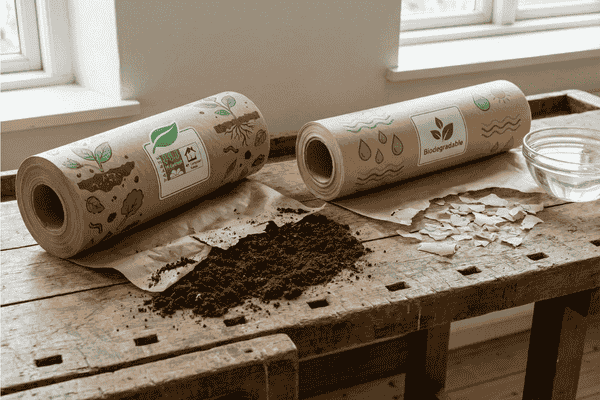
The two rolls of paper film were labeled as biodegradable and compostable, respectively, and the different external environments showed differences in the material decomposition.
Biodegradable and compostable paper films were compared side-by-side, with a focus on their decomposition under different environmental conditions.

I like to start with definitions because they shape your whole packaging strategy. Many “biodegradable” plastics will break down eventually, but they might take decades and can leave microplastics behind. Compostable films, by contrast, are tested to disintegrate and biodegrade within months in industrial composting, with limits on heavy metals and ecotoxicity so the final compost is safe for soil. (Sustainable Business Magazine)

Key Terms You Need to Know

TermWhat It Really MeansWhat It Does Not Guarantee
BiodegradableMicrobes can break it down at some point in some environment.No clear time frame, no clear place, may leave residues
CompostableMeets standards like EN 13432 / ASTM D6400; disintegrates and biodegrades in months.That your local composter will actually accept it
Home compostableDesigned to break down in a backyard compost at ambient temperatures.Industrial performance or long shelf life

Sources like Good Start Packaging and other certification bodies stress that compostable claims must be tied to standards such as EN 13432 (EU) and ASTM D6400 (US), while generic “biodegradable” claims are now viewed with growing skepticism by regulators. (Good Start Packaging)

Industrial vs Home Compostable: Why It Matters for Food Brands

From my experience with customers, this is where many projects go wrong. PLA-based films, for example, are certified compostable under industrial conditions, but they need high heat and controlled moisture to break down. If your main markets lack industrial composting, those packs may still end up in landfill. (MDPI)

Home-compostable films (often based on PHA, cellulose, or seaweed) are different. They are designed to break down at normal outdoor temperatures in a simple garden compost bin. Brands like Notpla use seaweed-based coatings that safely disappear in weeks and avoid microplastics and PFAS. (Notpla)

So when I help customers choose structures from China, I always ask three questions before we even discuss price:

  1. Where will your packs most likely end up: industrial compost, home compost, landfill, incineration?
  2. Does your target market accept certified compostable packaging from bodies such as BPI or similar? (BPIWorld)
  3. Do you need clear “home compostable” wording on pack to match your brand promise?

Only when we answer above can we decide whether to go with an industrial-compostable PLA blend, a home-compostable cellulose film, or a simpler paper-based compostable structure.


Can Biodegradable Materials Really Protect Food Shelf Life?

When I speak with R&D teams, their biggest fear is simple: “If I switch to biodegradable films, will my shelf life drop and cause returns?”

Biodegradable materials can protect shelf life and food safety, but only when you match barrier performance—oxygen, moisture, and light protection—to your product, your storage conditions, and your distribution chain. Some products work perfectly with simple compostable films; others still need high-barrier structures similar to conventional plastics.

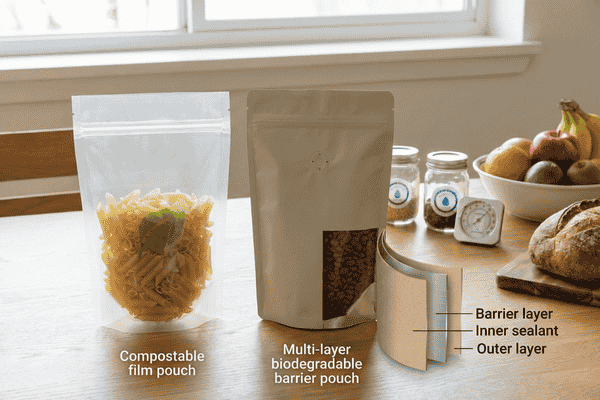
Comparison of a compostable film pouch and a multi-layer biodegradable barrier pouch, including a cutaway showing outer, inner sealant, and barrier layers.
Biodegradable packaging bags offer different levels of barrier protection. Some products are suitable for simple compostable films, while others still require multi-layered structures to prevent oxygen and moisture from entering.

I remind customers that a “green” pack which lets products spoil early is not sustainable at all. Food waste has a much higher carbon footprint than the packaging. So my first step is always to map the product risk: is it crispy, oily, fresh, frozen, or very sensitive to oxygen? Only then do we compare biodegradable options against a clear performance target, not just a marketing goal.

Barrier Basics: What You Must Check

FactorWhy It Matters for Shelf LifeTypical Biodegradable Options
Oxygen barrier (OTR)Prevents oxidation, off-flavors, rancidityPLA blends, PHA, coated cellulose
Moisture barrier (WVTR)Keeps crackers crispy, powders free-flowing, bread from drying outPLA/PBAT, PHA, coated paper
Light barrier (UV / visible)Protects color, vitamins, aromas (tea, snacks, oils)Metallized compostable films, pigmented layers

Research shows that modern biodegradable polymers such as PLA, PHA, and starch blends can achieve barrier levels comparable to those of many fossil-based structures when used in multilayer laminates, especially for bakery goods and fresh produce.

Real-World Performance: Where Biodegradables Work Best

From what I’ve seen in actual projects, biodegradable flexible packaging performs especially well in:

  • Dry foods with medium shelf life
    Tea, coffee beans, nuts, granola, dried fruits—especially when you combine compostable films with paper for a natural look.
  • Short to medium shelf-life chilled products
    Bakery, sandwiches, and ready meals that sell quickly and do not need one-year shelf life.
  • Fresh produce
    Compostable films with the right breathability can actually reduce mold compared with very tight conventional plastics.

One of my US customers in the organic tea segment, Herbal Goodness, moved all their stand-up pouches to PLA-based materials. Their brand is built around organic and fair-trade teas, so the switch to compostable packaging fits the story and supports their retail positioning. At the same time, we made sure the new film reached similar moisture barrier performance to their old PET/PE pouch, so their shelf life in US distribution did not change.

If you would like to learn more about barrier performance solutions, you can visit our Rollstock page to view more products or contact us directly for help.


What Are the Top Biodegradable Materials for Food Packaging: PLA, Cellulose, or Starch Blends?

When I help buyers choose a new structure, they often tell me: “I see so many names—PLA, PHA, cellulose, starch. Which one is right for my product?”

PLA, cellulose films, and starch-based blends all play different roles. PLA gives you clear, stiff films that run well on many lines; cellulose offers excellent heat resistance and a premium “paper-like” feel; starch blends help lower cost and speed up degradation but need careful design in humid conditions. (ScienceDirect)

Biodegradable raw materials including PLA pellets, cellulose fibers, and starch powder blends displayed on a wooden table for sustainable packaging applications.
PLA pellets, cellulose fibers, and starch-based powders — three core biodegradable raw materials used to produce sustainable flexible packaging.

I prefer to think of these materials as tools in a toolbox, rather than competitors. Each material has its advantages and disadvantages, and the best structure often combines them with layers of paper or other bio-based materials. When I face a client, I don’t simply reply, “We have PLA.” I ask for complete product specifications and their packaging expectations. This way, I know exactly which film will meet their requirements.

PLA: The Workhorse for Many Food Brands

PLA (polylactic acid) is made from fermented plant starch (usually corn or sugarcane). It is already widely used in cups, trays, and flexible food packaging films. (MDPI)

Where PLA works well:

  • Clear pouches where product visibility helps sales
  • Packaging for tea, coffee, snacks, and powdered products
  • Short to medium shelf-life applications with controlled temperatures

Key points you should know:

  • Industrially compostable (needs high heat and controlled conditions)
  • Good print surface and stiffness, similar to PET
  • Can be brittle if not blended with flexible polymers

Cellulose Films: Paper Feel with Film Performance

Cellulose films are regenerated from wood pulp. They look and feel closer to paper but behave like a technical film on the machine.

They are a strong option when you want:

  • High heat resistance (some grades can handle oven use)
  • A natural, matte look that still seals well
  • Home-compostable performance in the right grades (ScienceDirect)

Cellulose often pairs nicely with paper-based roll stock when you need a premium yet compostable solution for dry foods. If you are planning a similar project, please consider our Bio-based paper rollstock products from China.

Starch Blends: Cost-Effective and Fast to Degrade

Starch-based materials are derived from crops such as corn and potatoes. On their own, they are too sensitive to moisture, so you usually see them blended with other biodegradable polyesters.

They can be very useful when you:

  • Need fast degradation and simple structures
  • Want to keep costs closer to conventional plastics
  • Work with dry foods or short shelf-life goods in lower humidity

Here is a simple comparison I often share with buyers:

MaterialMain StrengthsMain LimitsTypical Uses
PLA filmsClear, stiff, industrial compostable, good printNeeds high heat to compost, brittle if unmodifiedStand-up pouches, snack bags, tea
CellulosePaper-like feel, good heat resistance, home compostNeeds coating for moisture barrier, higher costBakery wraps, premium sachets
Starch blendsLow cost, fast degradationMoisture sensitive, lower mechanical strengthSimple bags, liners, some snack packs

If your product falls under the tea and coffee category, you can also refer to our page on the tea and coffee market, where you can learn more about specific packaging options.


How to Match Materials to Your Brand and Supply Chain

Before I recommend any specific film from a Chinese supplier, I walk through a simple checklist with the customer:

  1. Product risk
    • Is it dry, fatty, liquid, or very oxygen-sensitive?
  2. Target shelf life
    • Three months, six months, one year?
  3. Sales channels
    • E-commerce, supermarkets, foodservice, or all of them?
  4. Disposal story
    • Are you promising “home compostable”, “industrial compostable”, or just “reduced plastic”?

For example, a frozen snack might be fine in a PLA/PBAT film with good low-temperature impact resistance, while an organic herbal tea might be better in a paper/PLA laminate with a strong moisture barrier and a clear compostability label. When materials come from China, I also pay special attention to:

  • Coating weight and evenness of the sealant layer
  • Film thickness and tolerance
  • Seal strength data at different temperatures

These details matter more with biodegradable films because their sealing window is often narrower than standard PE or PP.


Need a Partner to Turn This into a Real Packaging Project?

If you want to move away from traditional plastics while ensuring food safety and controlling delivery times, I can help you compare packaging options such as PLA, cellulose, and starch-based solutions. We can jointly evaluate your product, machinery, and target market, then select 2-3 options, arrange a test rollout, and design a phased transition plan to ensure your existing product shelf life is not affected.


Conclusion

The effectiveness of biodegradable flexible packaging depends on a combination of suitable materials, shelf-life requirements, and end-of-life disposal solutions, and all of these factors need to be carefully tested before scaling up production. Ultimately, what’s best for you is paramount!

Get Your Own Packaging

Choose XLD's experts to perfect your packaging!

Koy Wang

Koy Wang

Flexible Packaging Specialist
B2B Sales Consultant

8+ years in flexible packaging, specializing in paper-based laminates and rollstock for tea, coffee, and food brands. Supported 50+ global clients on packaging performance, cost reduction, and FDA & EU compliance. Serving brands and co-packers across North America and Europe.

8yr+ Experience
50+ Global Clients
2 Markets
About the Author

Related articles

One Way Degassing Valves: Essential Protection for Roasted Coffee Bags

Read More

Custom Printed Stand Up Pouches: Elevate Your Brand with Premium Packaging

Read More

The Ultimate Sustainable Flexible Packaging Materials List for 2025

Read More

Flexible Packaging vs. Rigid Packaging: Which Is More Cost-Effective for Your Supply Chain?

Read More

Chat on WhatsApp

Contact Form