
How to Choose Compostable Food Packaging Without Compliance or Shelf-Life Risks?
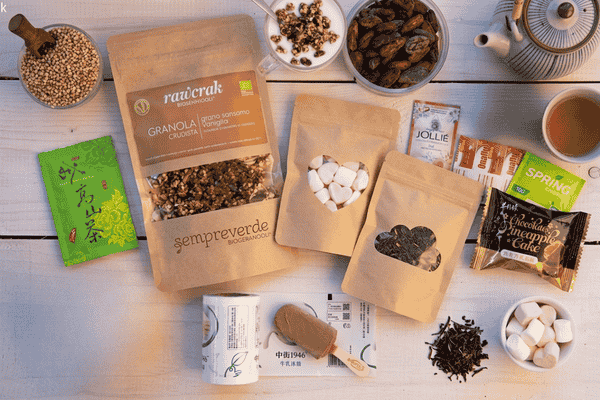
I often see teams rushing to adopt compostable packaging to keep up with trends, only to panic when regulators, retailers, or customers ask for certification because they can’t prove themselves.
I choose compostable food packaging safely by starting with certification and end-of-life reality, then checking barrier data and running a shelf-life trial before launch. When I follow that order, I avoid compliance trouble, greenwashing claims, and premature product failure.
If you sell food, you do not get a second chance at labelling. The steps below help you pick materials that pass audits, protect shelf life, and still make sense in real waste systems.
What Is Compostable Food Packaging and How It Differs from Biodegradable Materials?
I’ve personally witnessed a single incorrect word on a packaging label lead to legal risks, angry customer emails, and the unfortunate need to recall all stock.
I view “compostable” as a proven final disposal method under specific conditions, while the concept of “biodegradable”—unless it’s linked to recognized testing standards—is merely a vague one. This way, I can prevent my marketing claims from contradicting reality.
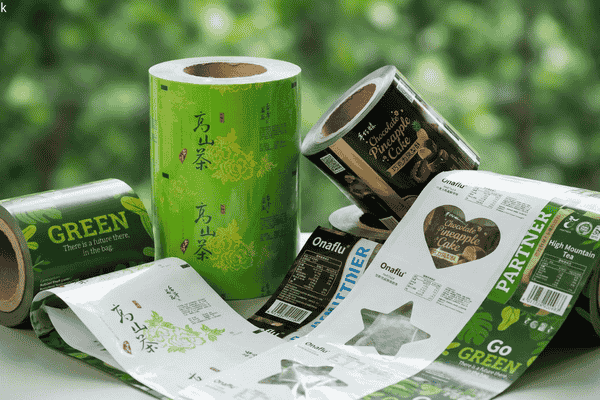
The difference that matters in the real world
When a buyer asks me, “Is this biodegradable?”, I counter with, “Under what conditions is it biodegradable? Within what time frame is it biodegradable?”
“Biodegradable” alone doesn’t provide any reliable information for regulators, composting plants, or consumers. In reality, even plastic can biodegrade, albeit over time measured in “hundreds of thousands of years.”
In contrast, “compostable” typically means the material meets specific standards and can decompose in a controlled composting process without leaving harmful residues. The key point is that what consumers care about regarding compostability is more likely simpler composting conditions than processing through industrial composting plants.
Two common reasons the terms get mixed up
1) Marketing teams want one simple claim
They want one short phrase that sells. But regulators want qualified statements, not broad ones.
2) Materials are often blends and laminates
To extend product shelf life, some packaging uses a mixture of materials. However, overall, this type of packaging is not fully compostable.
A practical comparison table you can use internally
| Term on pack | What it should mean | What often goes wrong | What I ask the supplier for |
|---|---|---|---|
| Compostable | Breaks down under defined composting conditions and meets a named standard | Certified film + non-certified ink/adhesive invalidates the whole pack | Certificate + bill of materials for all components |
| Home compostable | Breaks down in a backyard compost setting (lower temps, longer time) | Industrial-only material gets labeled “home” | Home compost certificate (not just “compostable”) |
| Biodegradable | Only meaningful with a standard + timeframe + environment | Vague claim implies “will disappear anywhere” | Standard name, test summary, and label wording guidance |
My Practical Application Scenarios
Right now, I do not pretend compostables can replace all traditional flexible packaging. In my experience, traditional plastic flexible packaging can only be replaced with compostable packaging in a few application areas:
- Packaging used for organic recycling systems
- Packaging that easily pollutes organic waste (for example tea bags and fruit labels)
- Food packs with heavy residue risk, like sauce packets
This is also why many well-known brands focus on compostable tea-related items first. I often see compostable tea bags used by brands such as PG Tips, Clipper, and Republic of Tea.
That pattern is not random. It matches where compostables solve a disposal problem and where regulators pay attention. You can also refer to our Tea Bag Packaging page to learn about our applications in this area.
Why Compostable Packaging Fails in Real Applications and Leads to Greenwashing Risks?
I’ve seen brands pay more for compostable packaging, only to find themselves unable to sell in stores or rejected by composting plants due to labeling issues, and losing consumer trust.
To avoid compostable packaging failures, I check three things beforehand: whether composting plants will accept it, whether the packaging structure extends the shelf life, and whether the labeling matches certifications. If I overlook any of these, the packaging could go from “sustainability” to “green marketing.”
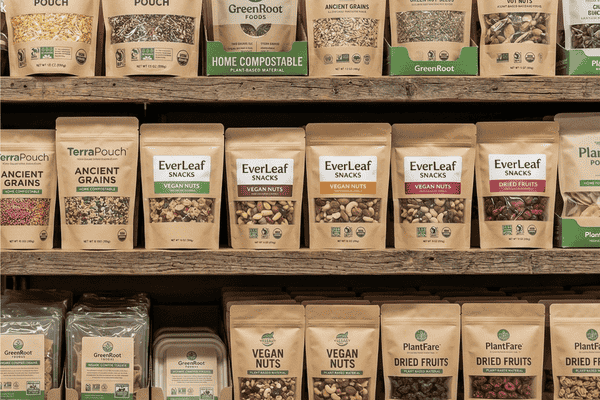
Failure mode 1: “Certified” does not mean “accepted”
A pack can be certified and still be refused in real collection programs. That is why some laws and buyers focus on acceptance rates and market access, not only test results.
For example, California’s compostable food service packaging rules can require that a product be collected and accepted by at least 75% of relevant programs and facilities (with an effective date referenced in the regulation). (Cornell Law School)
If a brand sells its products in stringent areas without verifying actual recycling availability, it could end up with packaging labeled “compostable” but ultimately only suitable for landfill.
Failure mode 2: Shelf-life breaks because barrier needs were underestimated
Compostable materials are engineered to break down. That creates a real tension: the pack must remain stable through distribution, then degrade at end-of-life.
Common real-world shelf-life pain points:
- Snacks losing crispness due to moisture ingress
- Coffee losing aroma due to oxygen transmission
- Powder clumping due to humidity swings
- Seals weakening when films have narrow heat seal windows
This is where many projects fail: teams switch material first, then ask “Why did the product go stale?” I always reverse that sequence. I start from the product’s moisture and oxygen sensitivity, then pick the compostable structure that can meet it.
Failure mode 3: Components quietly break the compostable claim
Even when the base film is certified, the whole pack can fail the claim if any major component is not compatible.
High-risk components that I always audit:
- Adhesives (especially for laminates)
- Inks and overprint varnish
- Labels and label adhesives
- Zippers, valves, spouts
- Window films on paper packs
If a supplier cannot state that all parts match the claim, the claim becomes fragile.
Failure mode 4: The wording is too broad, so regulators treat it as deceptive
Most “greenwashing” problems stem from unclear statements. If packaging is only suitable for industrial composting, the label must not imply it is also suitable for home composting. This is something many customers fail to do; they often neglect to include instructions for disposing of the packaging.
I keep language tight:
- “Commercially compostable where facilities exist”
- “Industrial compostable, not suitable for home composting”
- Use the certification mark + clear disposal instruction
A simple “greenwashing risk check” you can use before launch
1) Waste-path check (fast reality test)
- Where will most customers dispose of it?
- Is there a local compost stream that accepts this format?
- Will the pack be food-soiled (and therefore not recyclable)?
2) Evidence check (proof audit)
- Do you have a valid certificate for the final pack format?
- Do you have component confirmation for ink/adhesive/labels?
- Can you show barrier and seal data that matches shelf-life needs?
3) Label check (claim discipline)
- Is the claim qualified to the right composting type?
- Does it avoid vague “eco-friendly” language without proof?
- Does it match local truth-in-labeling rules where you sell?
How to Select Between Industrial and Home Compostable Structures?
I see many brands choose “industrial compostable” by default, then realize customers have no way to compost it.
My approach to choosing between industrial and home compostable packaging is based first on the consumer’s actual disposal needs, and then on matching the appropriate certifications. This reduces the risk of complaints while providing a more convenient solution for consumers.
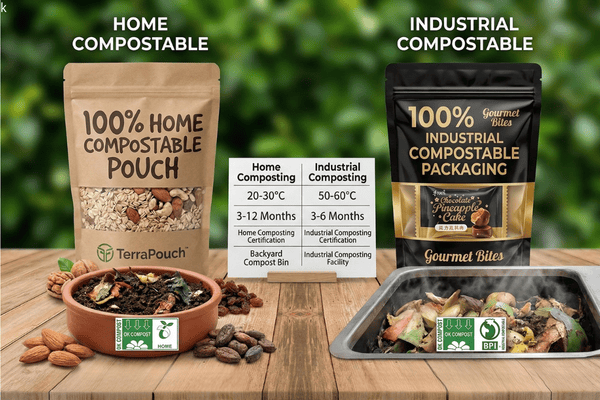
Industrial vs home composting is not a small detail
Industrial composting is usually hotter and more controlled. Home composting is cooler, slower, and inconsistent.
BPI notes that its Home Compostability Certification Program was launched in 2025 and is based on the French standard NF T 51-800, and that commercial certification is a prerequisite for home certification. (BPIWorld)
That matters because “home compostable” is a higher bar in many practical ways.
A selection framework I use (short, decision-first)
1) Start with disposal pathway
- Closed-loop foodservice with compost pickup → industrial compostable can work well
- Direct-to-consumer retail across mixed infrastructure → home compostable may reduce claim risk, but options can be narrower
2) Match structure to product stress
- Hot foods, greasy foods, or liquids → molded fiber + certified coating may be safer than thin films
- Dry snacks, powders, coffee → high-barrier compostable laminates are possible, but must be proven with data and trials
3) Decide how strict your claim must be
If your marketing insists on “home compostable,” you must be ready to limit structures and components more aggressively.
Industrial vs Home compostable: a practical comparison table
| Decision item | Industrial compostable | Home compostable | What I do before I choose |
|---|---|---|---|
| Typical environment | Controlled, high heat, managed process | Variable, cooler, slow | I align claim to real customer disposal |
| Claim risk | Lower if facilities exist; higher if not | Lower “facility gap” risk, but harder to qualify | I choose based on where the pack will actually end up |
| Material options | Broader range of biopolymers and coated papers | More limited, needs proven breakdown at low temp | I shortlist only certified structures |
| Best-fit applications (often) | Stadiums, cafeterias, events with compost collection | Some retail use cases where home compost is realistic | I select based on distribution channel |
This proves my point
This is why I believe compostable materials are best suited for products such as tea bags, fruit labels, and sauce packets that contain food scraps. In these cases, the advantages of composting are obvious, and both the product and packaging can be directly disposed of in the organic waste sorting process.
If the application scenario does not fall into the above categories, I would consider compostable materials as an alternative rather than a simple direct transition.
What Certifications and Labeling Requirements You Must Verify Before Launch?
I have seen teams order film samples, print artwork, and only then ask for certificates. That is the expensive order.
My method for verifying compostable packaging is first to have the supplier provide the certificate, scope of application, and component list, and then write the label based on the certification’s actual content. This avoids the hassle of reprinting, relabeling, and compliance issues.
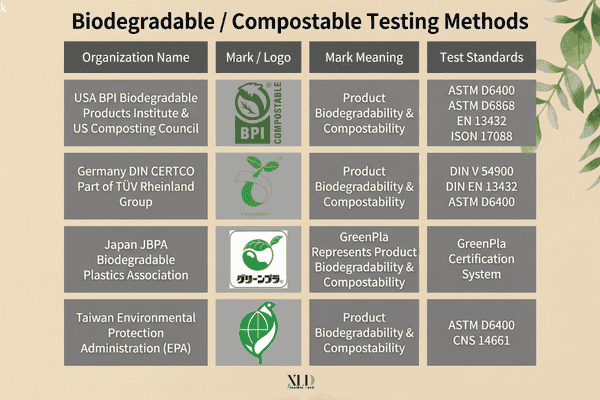
The minimum certification checks I never skip
1) Confirm the exact standard and what it proves
In the EU, EN 13432 is the common reference point for industrial compostability claims. One industry summary of EN 13432 requirements describes at least 90% conversion to CO₂ within six months under industrial composting conditions and disintegration so fragments pass through a 2 mm sieve after 12 weeks. (Taghleef Industries)
That level of specificity is what regulators expect.
2) Confirm the certificate scope matches your final packaging
- Film-only certification is not the same as certification for a finished pouch with ink, adhesive, and accessories.
- Ask whether the certificate covers your thickness, structure, and format.
3) Verify every meaningful component
I do not accept “it should be fine.” I ask for written confirmation (or component certificates) for:
- inks and varnish system
- adhesive system
- labels and label adhesive
- closures (zipper, spout, valve)
A launch checklist table you can use with your team
| What to verify | What to request | What to store for audits |
|---|---|---|
| Certification | certificate + standard + issuing body | PDF certificate + renewal status |
| Scope | thickness, format, intended use | certificate scope page + product code |
| Components | ink/adhesive/label/closure statements | signed BOM confirmation |
| Labeling | claim wording + disposal instruction | artwork proof + legal signoff notes |
| Market rules | state/country claim restrictions | compliance memo per market |
Labeling rules: keep it clear, qualified, and consistent
I keep labels simple:
- Use the certification mark that matches the claim
- Qualify the claim when infrastructure is limited
- Avoid vague “eco” language that implies benefits you cannot prove
And if you sell into states with strict rules, do not assume one label works everywhere. Some markets ask for proof of acceptance, not only a certificate.
You can also check our Sustainability Page for more information.
Request a Compostable Packaging Compliance Review
Based on your product type, shelf-life target, and market regulations—before switching materials. Share your food category, filling temperature, target shelf life, and where you sell. I will help you map industrial vs home compostable choices, confirm the right certification path, and reduce greenwashing and relabeling risk before you commit.
Conclusion
The following methods can significantly increase the likelihood of safely choosing compostable food packaging: first, match the actual packaging disposal practices in the customer’s local area with the certification; then, verify the shelf life through barrier data and testing; and finally, determine compliant labeling before the product is launched on the market.
Sources (External links)
- EN 13432 compostability criteria summary (90% CO₂ within 6 months; 2 mm sieve after 12 weeks): https://www.ti-films.com/story/en-13432-the-gold-standard-for-compostable-packaging-in-taghleef-industries-nativia-solutions/ (Taghleef Industries)
- California compostable acceptance requirement example (75% acceptance/collection threshold in regulation): https://www.law.cornell.edu/regulations/california/14-CCR-17989.5 (Cornell Law School)
- BPI home compostability program note (launched 2025; based on NF T 51-800; commercial certification prerequisite): https://bpiworld.org/compostability-certification (BPIWorld)